


 It’s About Relationships
Consumer technology is about more than isolated systems. A smart bulb isn’t very useful until it is part of a system. The Internet protocols have been key to enable use to build systems by focusing on the relationships between endpoints rather than all the complexities of each connection. But there’s a problem – the DNS names to maintain connectivity expire every year making failure the default because they use meaningful words rather than abstract identifiers.
When I first started working on home networking at Microsoft in the 1990s the term conflated home control with other aspects of networking. My first step was to enable packet-connectivity apart from any particular application.
I was also thinking about enabling technologies for home control and realized there was no protocol for something as simple as maintaining a relationship between a controller and a device. In those days we didn’t have smart phones and smart bulbs, so the goal was to connect a light switch to a light fixture.
I quickly discovered there was no standard protocol for such relationships. The IP address was supplied by an ISP. The DNS names weren’t much better since, by default, they expired every year!
I finessed the problem by using the NAT (Network Address Translator) to give one stable address within the home but that didn’t solve the problem of addresses beyond between homes and other local communities.
Rather than inventing an entirely new mechanism for stable relationships we can build on the existing DNS and provide DNS entries (and URLs) that never expire.
We Can Have Forever URLs
 A Forever URL is one that never expires. You own it and needn’t worry about forgetting to renew it. The term itself is inspired by the US Forever Stamps, which you can use even if the postal rate goes up.
This article looks at the underlying mechanisms for linking such information and is aimed at a technical audience. The DNS isn’t just about websites, it is fundamental to how we connect endpoints be they websites, devices, documents etc.
 As bit.ly and others have shown, there is no technical reason URLs need to be renewed each year. (You can prepay for a limited number of years but that doesn’t address the underlying problem.). The cost of a URL like (http://bit.ly/3lbyyCI) is so low that bit.ly doesn’t require an annual renewal. There’s even a free tier.
The URL can be represented as a QR code on posters, printed publications, TV, etc. In this way the identifiers can be used to link objects in both the physical and online worlds. Bob Kahn’s Document Object Identifiers (DOI) was created to assure the long-term stability of references among publications. Websites and devices need the same persistent connections.
While bit.ly and DOI provide important capabilities, we need an approach that doesn’t depend on third parties. One that is directly supported by ICANN to ensure that such links last as long as the Internet itself.
The other endpoint identifier, the IP address, is only valid for a short period of time and can change when an ISP makes changes. Today, DNS entries are also ephemeral. This becomes a problem when building devices that have to work as infrastructure. We have lots of workarounds. That isn’t a substitute for having a standard that allows for cooperation across systems.
The more fundamental problem is that the very idea of a name being globally unique doesn’t make sense whether it is “John Smith” or “House-Of-Pizza”. And why is “HouseOfPizza” different from “House-of-Pizza”? It’s worse than user hostile. It created security risks. Typos are dangerous. There is a reason why real trademarks take into account human factors.
User Experience
The goal is a seamless user experience. Today we’re already used to clicking on a link on a web page or in a search result and are inured to the 404s. As computers become increasingly embedded in our lives, these annoyances accumulate to the point that older sites are full of stale links. We can’t prevent sites from going away, but we eliminate forgetting to renew as a source of failure.
“3lbyyC” does not look friendly. But it’s no different than a phone number. 1-800-555-1234 written as “1zjWS6” using the letters of the English alphabet and ten digits. Normal people should never deal with the identifiers directly. They would use tools provided by others. Today’s tooling isn’t there, and users can continue to use traditional links if they choose, but, increasingly, the tooling would transparently convert from familiar names to Forever URLs. Today’s search engines already translate names into long URLs, but you don’t have to know them – you just click on the links.
There are other benefits to such identifiers. Today, your email address is tied to a provider (name@comcast.com), and if you switch providers, your email address becomes invalid. We can use the DNS to store email addresses in the same way we use it for links to sites. It would work like phone numbers. People could list themselves in public or private directories or give them to others directly. Users could also generate derived addresses to control access and improve privacy. If you switch providers, your address stays valid even if you are no longer listed in a particular provider’s directory.
The use of abstract identifiers may look complicated, but the result is a simpler and better user experience because we are honoring the design point of the Internet by moving the user experience from the DNS to the applications that can take into account human factors and application needs.
Why are we in this Fine Mess?
The DNS evolved over the years. Initially, each computer would have a simple file (“hosts”) to map friendly names to IP addresses. We moved to today’s hierarchical system without revisiting the basic assumption that it was obvious what the names should be. But which is the real Miami.Edu in the US? Is it the one in Ohio or the one in Florida? Using meaningful names created a marketplace that denied people ownership of their own identities. The names must default to failure otherwise you can’t force people to pay for renewing the lease on those identities. This would be true even if the price we essentially zero. It’s similar to the free rider problem on a railroad – you don’t get a free ride if you don’t have a ticket.
It’s nice that I can have 方思腾.香港 as a domain name. Because the DNS only allowed ASCII strings, Punycode was invented to represent it as https://xn--fiq22j2k1a.xn--j6w193g. That isn’t very friendly and adds complication without providing the benefit of persistence. Instead, we can use a Forever URL behind 方思腾.香港. We lack the tooling to make Punycode work transparently – we have to work with the xn (Punycode) names directly.
When we localize a web page we don’t change the URLs – so the idea of encoding the local language in the URL doesn’t even help us! Using 3Yz1Klp with tooling is a better approach, with the benefit of never having to expire.
Treating the DNS as a directory is problematic and, more to the point, unnecessary. We have better ways giving people the ability to find what they want.
Tooling
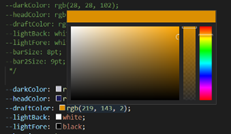 Today we have the tooling to make it easy to work with colors in CSS. You don’t have to think about what #fb837f means – you can just point to the popup in Visual Studio Code.
The same approach can work for Forever URLs and other objects.
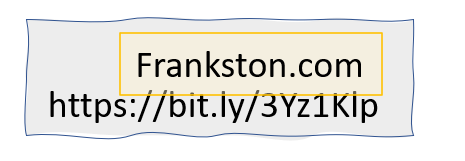 Sites that offer web hosting for less technical users can seamlessly embed support in their site-building tools. In a sense, it’s like pointing to a cell in a spreadsheet and not thinking about a name. You’d point to “that” site, and it would translate it into the appropriate URL. We see some of this when using Facebook or Twitter, and when we type @, we get prompted with possibilities. Internally those strings link the abstract user identifiers.
Initially, there would be limited demand for such tooling. As people begin to use Forever URLs, they will drive a virtuous cycle. The more people use the URLs, the more demand for even better tooling. As the tooling improves, we’ll see a transition from traditional URLs to Forever ones.
Sustainability
The cost of storing an identifier forever is essentially zero. A small one-time fee would cover the lifetime cost of the few bytes necessary to store the information. Additional services, such as maintaining a zone file1, could have a fee.
There would also be a market in providing innovative directory services, taking into account human factors as with trademarks. This would create stakeholders in the new landscape.
Using GUIDs
The world is held together by GUIDs (Globally Unique Identifiers2). These are just bit strings without any inherent meaning. Because they are long and random, they can be treated as unique without central coordination.
Nonsemantic links are fundamental and allow you to change your name without losing the connection to your medical benefits. If anything, the surprise is that this is not used for the DNS, so we wouldn’t have to worry about which “House of Pizza” is the real one. You’d look up the name in your local directory. That is why search engines use location information to provide the answer when you ask for the name of the businesses.
Storing the identifiers in the DNS has another benefit – asserting ownership. Because the addresses are persistent, there is no need to consult the DNS to see if the identifier has been used. A security certificate using the GUID would remain valid forever. That is important for embedding certificates in devices.
A full discussion of the power of such identifiers is beyond the scope of this article. What is surprising is that the DNS is the exception to standard practice. Without effective tooling, it may have been difficult to work with GUIDs in the past.
As our world becomes increasingly defined by software, GUIDs enable us to link devices, documents, contacts and so much more because they do not have inherent meaning. That gives the users the ability to define their meaning just as the Internet packets allow us to use a common infrastructure for visiting websites, carrying on voice conversations, streaming and, again, so much more.
Having Forever URLs is a key part of the next stage of the Internet – one in which we assume peer links between devices without having to “access” the Internet as such. We can also look beyond the DNS for managing the GUIDs but that is a large topic in itself.
Just think of being able to visit your doctor’s office and getting a glucose monitor that works in the office, while you’re on the bus on the way home and while your at home with no setup, no need for a smartphone or an account. It just works everywhere. Forever URLs coupled with a public packet infrastructure can make this happen seamlessly. That delivers on the promise of promise of the Internet and can have a dramatic impact on people’s quality of life.
What are we Waiting for?
A key element of this approach is that it uses the existing DNS as is. This means the transition can occur as users see benefits rather than having it forced and them and without having to wait for the tooling. It is about policies based on recognizing the importance of a DNS that provides a mechanism for stable relationships and one that shifts human factors (such as meaning) outside of the infrastructure, just as the Internet moved us from smart networks to smart devices.
The Forever URL provides an opportunity for a more stable Internet and the ability to innovate beyond the web. Using unique identifiers for linkage is a fundamental concept in computer science and, for that matter, in building any system. Why are we still using a system more suitable for small workgroups than a global Internet?
Forever URLs provide a stable foundation for the evolving role of URLs. Search results will stay valid. New directory services can help people find business. People can manage their visibility in those directories and synchronize them with personal address books. The relationships between connected devices can be built on standard protocols.
We have a choice – will the future Rosetta Stone be written in granite, or will it be written in sand that washes away in a year?
ChatGPT Version
As an experiment I had a conversation with ChatGPT about the topic and then asked to summarize the paper:
Title: Forever URLs: Enhancing Web Addressing with GUIDs
The web is an ever-evolving entity, with content constantly being added, moved, and removed. This dynamic nature, while a strength, also presents a challenge: link rot. Link rot occurs when URLs, or web addresses, become obsolete or broken over time. This can happen when the content they point to is moved, deleted, or when domain names expire and are not renewed.
To address this issue, we propose a new approach: Forever URLs.
What are Forever URLs?
Forever URLs are a new way of addressing web content that leverages Globally Unique Identifiers (GUIDs). Unlike traditional URLs, which are based on the location of content, Forever URLs are based on the identity of the content.
GUIDs are long, unique strings of characters that can be generated without a central authority. They are designed to be globally unique, meaning that no two GUIDs should be the same, regardless of where or when they are generated.
How Do Forever URLs Work?
Forever URLs work alongside the current Domain Name System (DNS). When a new piece of content is created, it is assigned a GUID. This GUID is then used to create a Forever URL for the content.
The key advantage of this approach is that the GUID remains the same, even if the content is moved or its traditional URL changes. This means that the Forever URL will always point to the content, preventing link rot.
Why Use Forever URLs?
- Coexistence with Current DNS: Forever URLs don't replace the current DNS system; they coexist with it. This allows for a gradual transition and doesn't disrupt the existing infrastructure.
- User Control Over Bindings: Unlike current DNS entries that expire and can potentially be taken over by others, GUIDs remain under the control of the original user. This allows users to manage their bindings more securely and flexibly.
- Immediate Usability: This system can be used immediately, without waiting for universal adoption. This allows for early adopters to start benefiting from the system and can help drive broader adoption over time.
- Enhanced Security: The use of GUIDs can potentially enhance security by preventing unauthorized takeover of expired DNS entries. This is a significant improvement over the current system.
In conclusion, Forever URLs present a forward-thinking approach to web addressing. By leveraging the strengths of GUIDs, we can enhance the security, flexibility, and resilience of web addressing, ensuring that our web content remains accessible, now and forever.