


Contents
- Preface to the Preface
- Doc Searls’s Intro
- Preface
- Language
- Repurposing without Renaming
- A Brief History of Telecommunications
- The Dialup Internet
- Modems
- Networks and Network of Networks
- The Dial-Up Internet [sic]
- Home Networking.
- Sharing the “Pipe”
- Broadband, Cable and DSL
- Information Service: A Conflict of Interest
- Internet?
- Wireless and Radios
- Today’s Internet
- A Powerful Idea and a New Paradigm
- The FCC and PTTs … and a reboot
- Building on the Ideas
- Further Reading
- In-Progress
- Why Best Efforts Won!
- Longer Snippets
- Origins Of Telecommunications
- Personal and Other Computing
- Scratching the Surface
- Word List
Preface to the Preface
I’m posting this as a work-in-progress and would appreciate feedback. I’m posting now because it is important to provide an understanding of the basic concepts and make explicit assumptions visible.
Warning: This is a first draft, and there are many typos that are spelled correctly but are the wrong word. If what I say doesn’t make sense, it is likely I have the wrong word – whether auto-correct are whole-word typos.
Update: In the Scratching the Surface section I’m starting to add short additional observations that either deserve their own essays in the future or need to be integrated into the main text.
There is a lot here, and in later sections, there is a deep philosophical dive more for wonks than casual readers. My goal here is to get the ideas out in a first draft and, hopefully, find an initial audience.
I go from the basic vocabulary we use to talk about the Internet vs. traditional telecommunications. I then drill down how we think about the Internet (and connectivity) and then take a deep dive into philosophy.
These are all intertwined as the Internet is a laboratory for understanding new concepts, and software (AKA information science) gives us the vocabulary and conceptual framework.
I’ve found that if I start with a deep philosophical dive, there is little interest, so I organized this:
- Look at the words we use and how we understand the concepts of connectivity.
- More about best-efforts and related concepts
- The deep topic of resources vs. layers
- Policy implications and engineering.
This is still the very first draft with many typos, so it is only for the brave, but all feedback is appreciated.
Doc Searls’s Intro
Nothing is more important in the world today, or in anyone’s life, than the Internet. And nothing has changed all of our lives more. Wouldn’t it help, then, to understand it? Most people don’t. That lack of understanding even—or especially—includes people working for the companies we pay for access to the Internet: the phone and cable utilities of the world. It also includes the .org, .edu and .mil entities as well.
Do you think somebody owns the Internet? Or that its owners include the “carriers” and “providers” of the world. That’s wrong. Nobody owns the Internet, just as nobody owns the atmosphere we breathe, the gravity that gives us down and up, and the languages we use to make sense with each other. It’s that deep and fundamental but far less understood.
Preface
The Internet is built upon a powerful idea of separating meaning from the means we use to communicate. It’s difficult to talk about these because every word we use has baggage. That is the nature of language.
This is a difficult concept that I compare with the shift from geocentrism to heliocentrism, with meaning coming from context and not being intrinsic. Traditional telecommunications transports “meaning” as a service. The Internet does the opposite – the meaning is entirely outside. At least in theory. In practice, it’s more confusing partially because it’s an engineering prototype that doesn’t attempt to change everything at once and partially because the concept of decoupling meaning from transport is very difficult and is often fumbled.
The Domain Naming System (DNS) is a case in point. It only allows one Joe.Pizza in the entire world! And if you change the name, everything breaks! We’ve known that you use an abstract identity such as, in the US, a social security number. You can freely change your name without becoming unlinked from your benefits.
Another example is the idea of home automation as fundamental rather than just being a use case.
To understand this, we need to think about the very words we use to communicate, starting with the word “communicate” itself.
Language
Seymour Papert had a great influence by helping me understand concepts. One of them was the idea we communicate by establishing a shared framework. He was a student of Piaget who studied how children built up their conceptual models of the world.
One of his points is that we’ve repurposed words to describe human behavior in order to talk about computers. It’s our only vocabulary for systems with agency. This isn’t new – we (as a species) used the same approach in understanding the world, giving rise to animism – the idea that human-like gods determined our fate.
The same problem arises when I try to talk about the concepts upon which the Internet is built, but I have to use the words from the so-called telecommunications industry. And that’s a good starting point for looking at how language hinders our ability to communicate by enabling us to share words without a shared understanding.
A simple example is the measure of work. We know that the way we measure work in physics (in ergs) has little bearing on the amount we pay. It’s an “it goes without saying” thing. But when we repurpose a word like “broadband,” we act as if we understand what it means as a synonym for Internet.
What makes this so problematic is that I have to use the vernacular in order to start a conversation because the technical terms prevent communication. So, I risk miscommunicating in order to communicate at all.
This is the nature of language; it evolves by using a single word for shared concepts, but when those concepts drift apart, the language remains stranded in the past.
It’s a challenge to try to speak about the words apart because they are intertwined. When we communicate, we exchange information. But there are multiple interpretations – are we carrying bits in a “pipe,” or are we exchanging wisdom in context?
Communicate
We can think of people communicating as exchanging concepts by talking or writing. We’re also used to having third parties transporting messages, be it by runners or postal services. Those messages were transported like any other freight, and the job was to deliver the message intact.
It made sense to use the word telecommunications for communicating at a distance. In the 1700s, Napoleon has a telegraph system for sending messages, with telecommunications being a more general term.
There was no need to distinguish between the particular method of communicating and the word we use for speech.
At least not until the 1970s, when with the discovery of best-efforts, packet-based connectivity was introduced. I’m a bit sloppy here because there are earlier roots, but I see it becoming a key technology with the use of digital radio packet networks forcing us to program around the limitations of the pipe model.
Voice over IP (VoIP) works very differently. There are no intact messages in the path – just packets of bits without intrinsic meaning. We are no longer telecommunicating in the sense of transporting messages postal style. The meaning is between the endpoints – people or devices – and simply does not exist as such in the wire.
No wonder the groups like the IEEE Communications Society are confused because the technology has stayed the same, but the context has changed. I call this bitrot.
Think about it. There is essentially no relationship between the schools that teach communications technology and those that teach how to communicate. It is a marvel of language that we fail to see the obvious disconnect because we implicitly assume context. But this leads us to miss the point that the use of “communications” in the Federal Communications Commission is fundamentally ambiguous since they are managing meaning by managing technology with huge collateral damage due to the mistranslation.
Information
Claude Shannon did excellent work, but the tragic legacy of his choice of the term “Information” for entropy has led to trillions of dollars in harm. Spectrum allocation is one result.
There is no connection between his abstract measure of information and the exchange of meaning or wisdom.
It’s pretty obvious if you think about it. If you measure information in bits, how much information is in a pause. Since zero bits are going across the channel, there is something wrong with the question.
Shannon proposed a measure that was pure math. Once you encode the signal in a given way, you can then ask a question like – if I send 1024 bits over a channel that can transmit 256 bits per second, how much time will it take? Notice that this is a measure of capacity since the actual speed of electrons is the same. We can then say if I code the signal in a pulse, known as a baud, how can I construct a channel to preserve the pulse? And, since it is binary, how can I regenerate that pulse along the path? These are all vital questions, but they have nothing to do with how much meaning there is.
If I send 182818181, it might be an ISBN number that represents a 10,000-page encyclopedia or, today, https://wikipedia.org “transmits” the entire Wikipedia in 100 bits or so! Of course, I don’t really transmit the contents of Wikipedia through the channel! And that’s the point – meaning is not in the channel. We communicate by sending references – that’s fundamental to language. Words are symbols or references, and the meaning is not intrinsic! If I say “son” – you cannot know the meaning unless you know what language I’m using. Again. This is fundamental and intrinsic and entirely apart from the measure Shannon used.
One of the terrible consequences is that the idea of channels is used to justify turning radio frequencies into property in order to preserve meaning. Not only is this totally wrongheaded, but it also assures scarcity by letting people think there are only so many channels. And it gets worse since limiting ourselves to the pinhole of a channel creates the bogus idea of interference because we’ve thrown away any context thus, we get confused if there are two signals in the channel.
And thus, we create a worldwide police state to protect channels from interference even though, in physics, there is no such phenomenon.
But wait – it gets worse. Because we assume dumb endpoints – just carbon microphones and speakers – we must make sure there are no errors.
The Internet works on a fundamentally different principle, as I explain WRT to VoIP . I call it the “eh” principle. If you say “eh,” I’ll repeat what I said. Or you can guess from context. That’s why the original analog cell phones were fabulous, even if you could hardly hear the other person.
The other pernicious idea is “quality” of service, which was used to measure the lowest bit rate you could get away with and still get comprehensible speech. But because it had to word “quality,” it sounded like a good thing, not something you could get away with. And it gets worse since it was about quality within the channel. You couldn’t use context, and thus streaming wouldn’t work since you had to wait till the network assured all bits were perfect rather than using the intelligence at both ends to adapt dynamically.
Networks and Networking
The word network has no shared meaning. It is a mathematical construct. We have social networks, broadcast networks (a social network of broadcasters) and telecommunications networks.
Telecommunications companies sold services – the transport of messages as freight, just like the post office. With the advent of the talking telegraphy, they had to assure a clear channel to preservice the salient properties of the waveform of speech. Digital telephony did not change this – it just did a better job of preserving the waveform. Each kind of content (such as video) needed its own considerations and compromises.
The actual facilities were just a cost center that existed to sell those services.
I often compare their business of carrying messages on channels to railroads that sell rides as a service. The railroad business model is eerily similar to telecom to the point that the FCC was spun out of the ICC. Read Richard Whites Railroaded to learn more.
With roads, we composite a path out of local facilities, and we do the same with modern packet networks! The dirty secret is that the digital network never really worked because compositing a guaranteed path (Service Level Agreement) out of disparate telecom networks (ATM or Asynchronous Transfer Mode) was too complicated to work across carriers, so it relied on analog shims. This is why VoIP is so important – it put a lie to the need for guaranteed paths and thus to the idea we needed a telecommunications company to own the path and to charge us to use it. Instead, we can composite the path out of available facilities with no provider as such!
And it gets worse – now that the services are apps in our devices, none of the benefits of that value go to a network provider! Their greatest fear is becoming a dumb commodity pipe, but that’s a pipe dream since we don’t even need pipes at all. Their worse fear should be that they have no reason to exist and no way to capture the value of the services they enable. This is why we need to switch to a Public Packet Network (PPI) model paid for as we pay for any infrastructure – the value is in the whole, so the community comes together to pay for the whole.
It’s still a network but like a road network or social network and not a 19th-century telecom network.
As Doc Searls (reference) observed – you make money using networks and not by owning them.
Security
Who doesn’t want security and to be safe behind the castle walls? Just as the meaning of words isn’t kept within pipes,  we can’t define which bits are good and which are bad out of context. The very idea of “network security” is a nostrum without meaning.
Security isn’t a simple concept. A far better term is trust relationships. Even then, it is far from simple as there are people whom we might trust with our lives but not our money. Advice that may make perfect sense in one context may not work in another. Even when the advice is correct, we can’t be assured that all the implications play out as expected.
In the real world, we deal with this ambiguity and accept risks by trying to insure ourselves against the unexpected.
The idea of firewalls and perimeter security is pernicious in creating the illusion of security while leaving us vulnerable to the slights breach, with the story of the Trojan Horse being a cautionary tale. A better model is tentative trust coupled with continual reality-checking or verification. And insurance.
Another problem with the idea of network security is that it is typically tied to the accidental physical topology of an underlying network. I often use the example of a shared driveway light and the need to give my neighbor managed access so we can share control.
It would be nice if we could trust the phone company (the classic telecommunications provider), but the problems with caller-ID spam hint at the larger problem in that they can try to verify a billing relationship, but that says little about the trustworthiness of the other party.
Another face of the problem is HTTPS itself. All it does is verify that the string in the URL matches the name at the destination but says nothing about the site’s trustworthiness. There are also problems with eyeballing the string to see if it’s the same, but in many fonts, there are ambiguities, such as an r followed by an n looking like in m.
It would be nice if trust were simpler. It isn’t, and the heuristics we relied on in the physical world don’t translate easily into the electronic world, and our use of the same vocabulary for both worlds leaves us vulnerable.
Repurposing without Renaming
The term “telecommunications” is one example of a name that is more about the past than the present and thus permits stale ideas to persist.
A Brief History of Telecommunications
For millennia people have exchanged messages over a distance using runners and then postal services to carry the messages. In the late 18th century semaphores were used to exchange messages over a distance – tele-communicating. And by the 1830s telegraphy had come into its own. The business model was carrying messages as a service. These messages were freight and, in many ways, the business model parallel that of railroads. Even to the point that telegraph wires used the railroad’s rights-of-way!
The advent of the talking telegraph (phone calls) put a strong demand on the network because it required a dedicated path for each conversation in order to preserve the waveform between the microphone and speaker at each end. It was fit into the conventional pricing model by measuring each conversation in terms of message units (telegrams). The need for a dedicated path meant that even pauses required dedicated resources. Today that model persists with cellular calls still be charged for minutes – even when using Voice over IP (or LTE) which has no dedicated facilities.
The tendency to fit the new into conventional models is very strong which is why it is so important to make our implicit assumptions explicit so we can rethink them from first principles.
The business model of telecom has been to sell service such a voice as service and treat the infrastructure as a cost center. Today those calls are apps so why do we stick with the conventional model? Because … and, for many that’s sufficient.
The Dialup Internet
Modems
Before we get into specific terms, it is important to understand the concept of the dial-up Internet. The dial-up modem and the Internet had a fundamentally different purpose and were separate concepts.
The dial-up modem modulated/demodulated a data signal so it could act like a normal phone. It was a point-to-point connection and was used a century ago for teletypes. Those teletypes were later used as computer terminals, and we could extend the point-to-point wire by inserting a modem in the path, but it remained a point-to-point connection.
In the 1960s, we started placing small computers around the country. You’d do a point-to-point connection to the nearest computer, and it would tag the character so they would share the expensive long-distance wires. It was a way of using the point-to-point connection more wisely. This was networking implemented in software and was unrelated to the kind of networking done to route phone calls.
Later that approach was used for leasing higher-speed connections between computers in early networks modeled on point-to-point connections or “pipes”.
But, hey, networks are networks. And why we can’t communicate.
Networks and Network of Networks
As noted, computers started to interconnect by repurposing phone lines as data paths or pipes in the 1970s. One, in particular, is best known. The ARPAnet was made available to researchers and other members of the academic community. The goal was to make computing resources available and shareable.
By the early 1970s, we had various experiments with packet networks, but one that stands out is ALOHAnet in Hawaii, which used radios, and there were no networks as such. In Refactoring Consumer Electronics, I explain why that concept led to today’s Internet.
With the proliferation of networks, it made sense to interconnect or internetwork them. The pack-based approach of Aloha was the big idea (though it may have arisen independently) and a break from the past in which the network itself would take responsibility for the reliable delivery of the data.
I see Aloha as forcing the issue. Unlike a traditional network, there was no service provider and thus no network as such. The applications in the computer took over the functions normally assigned to a network operator, such as reliable delivery.
This decoupling of the meaning from the packets is a very powerful idea and a complete disconnect from the concept of networking provided by telecommunications providers. It changes everything, but that is not obvious because we can do such a great job emulating the old services that it’s not obvious that there is no longer a network operator behind the curtain. (Wizard of Oz reference).
The key to getting disparate networks to interconnect was not trying to do anything beyond forwarding packets without taking any responsibility for delivery. Hence, the term “best-efforts” meant you’d try your best but could make no promises. This is a term of art that confuses lay readers since best usually means the highest quality without acknowledging the limits.
For that matter, the idea of using what one might consider junk, AKA unreliable connectivity, to create today’s highly reliable Internet is counterintuitive. No wonder we fall back on folk explanations and view the Internet through the lens of typical telecommunications and the idea of pipes.
In a sense, this reflects the challenge in understanding that science can give us such seemingly reliable answers only because it does not promise to and thus has to keep restarting and adjusting as the context changes. Those with only a folk understanding of science attribute the reliability to discovering the one truth and sticking to it in a fundamentalist way.
Very simply, the Internet works because we cooperate on pooled resources and take responsibility in each device. If you see packets getting lost, you slow down. Video streaming works because instead of waiting for every packet, we use our computers to fill in the blanks.
This is another fundamental change—we can assume “smarts” at the endpoints and use cooperative protocols rather than relying on and paying for promises by a provider. In fact, by decoupling the meaning from the packets, there is no way to pay for preferences.
These networks became available to universities and researchers but were not available to the general public – or, at least, not officially. It was possible to exchange email between the wider world and the Internet through various gateways, and in about 1989, I set up Lotus.Com and got Frankston.com for email (the Web wasn’t a thing yet). I greatly regret I didn’t also get Microsoft.com which was available at the time.
To the users, the Internet isn’t so much a network as it is a shared environment. Any two people can plug in their computers and assume a relationship between the two of them without worrying about where the devices are or the intricacies of traditional networking. They could type http://info.cern.ch and expect it to just connect. And it still does more than 40 years later. This is not a traditional telecommunications network. It is a shared environment.
Distance no longer mattered for collaboration and crystallized around web protocols though there had been earlier efforts such as Gopher.
The Dial-Up Internet [sic]
As we’ve seen, we used point-to-point dial-up to reach computers. If you were at a university, you could take advantage of the interconnections with other systems using the ARPAnet and then the Internet.
Civilians (those not in the research community) would use their modems to dial into online systems for commercial use or for personal use. Among these were bulletin board systems (BBS). Once the restrictions on using the Internet were removed, those systems could interconnect using the same protocols as the universities and share the connectivity. They just had to pay the cost of leasing a line to an interconnection point.
By the 1990s, it was normal for computers to have modems, thanks to AOL and similar services. Adding web portals was an extension of the existing systems.
It is important to note that these were dial-up services at 1200bps and eventually reached 56Kbps, at which point they ran into the design limits of the purposed phone network. This had nothing to do with the physical limits.
There was some truth in this model – you dialed into a computer that was on the Internet. It isn’t dissimilar from the way that you could use a broadband connection using a cable modem (notice the use of the term modem) or a DSL connection.
DSL is interesting because it was originally ADSL – Asymmetric Digital Subscriber Line originally offered by the phone companies so they could get into the cable TV business in the 1980s. It was based on 1950s technologies though updated. The DSL model was fitted into the telephony world, with the Internet being treated the same way you’d choose your long-distance phone company in the 1980s (that’s a story unto itself). Very similar to the idea of dialing into a bulletin board system.
Most important – the dial-up model is inherently asymmetric. You are a client calling into a system, and the Internet acts like just another online system or BBS.
Since the underlying protocols are symmetric, you can run on a web server on a dial-up connection, but that is, at best, awkward.
The design point of the dial-up Internet was having a network with its own underlying protocols, typically ATM (Asynchronous Transfer Mode), to relay IP packets to the Internet as an online service.
Home Networking.
In late 1994 I was commuting to Microsoft from Boston (because they had no local technical facilities), and the computers within my home were all on my home network. I wanted them to share a single connection. But I had a single connection, but I found a neat hack – Network Address Translation (NAT) – that allowed me to share the connection among all the machines in my house.
I was used to programming within a campus or corporate environment in which you are simply connected to all other systems using a common IP medium, such as an Ethernet, and you have an IP address.
A subtle point here is that the Ethernet acts like a resource used to carry IP packets that are wrapped in Ethernet packets. We’ll get more into this in the discussion of layering.
By using the NAT, I was able to use the same IP protocol within my house and act as a symmetric peer with the rest of the Internet since the DSL and broadband paths were always on.
This is a fundamentally different way of thinking from dialing into a bulletin board when you want to read your mail. You could (as I did) run your website on your home computer and be available 24x7. In practice, it’s more reliable to use a hosting site but more about that later.
If you look at the details, you’ll still see an echo of the dial-up Internet with a cable modem playing the role of a dial-up modem and the IP packets being relayed over an ATM transport using a broadband or DSL connection. The IP addresses within the home weren’t public on the rest of the Internet, thanks to the NAT (though you could forward connections back into the home machines).
Perhaps this is why it was difficult for me to explain the concept of my home network (or corporate or campus networks) being peers to the rest of the Internet, even if all local connectivity used IP – those packets used a so-called access network to reach the larger Internet. And even though the local network used the same protocols as the Internet as a whole.
Sharing the “Pipe”
One way to think about home networking is that the original goal of providing a fat pipe into homes (broadband or DSL) was that the provider would use it to sell services. It was a bonanza for them – they could add an additional phone line without having to run a wire. They could own e-commerce by controlling the pipe (the previous attempt was the failed 900 number). ATT paid a huge premium to by MediaOne to get that revenue
By putting the NAT at the edge of the home, all that came crashing down. All the services in the home were commoditized, and all their saw were packets without any intrinsic value. They couldn’t charge a fee for each PC!
And it got worse as others discussed they could use generic connectivity to compete against the carriers’ services such as video (cable èstreaming) and telephony (voice èVoIP), and e-commerce (Amazon et al.). No wonder they need 5G to claw the value back – more of that below. As we’ve seen, that meant the value was no longer captured by the network owners!
I remember once trying to get an additional phone line (during a transitional period), but the installer was surprised to find a dial tone on an extra pair. The tone originated from inside the house via my phoneóInternet adapter. The tables had indeed turned.
And things will get far worse for the legacy providers once people understand what is happening. That single fat pipe is relatively inexpensive compared with the value we got (though far higher than the actual cost). But if neighbors share it, they won’t see any noticeable loss of capacity because of how well we can share the line. Providers already assume a high level of sharing, but an unshared business connection doesn’t cost much more. The advantage of sharing a single pipe is compelling. As we scale up, and for a city, there is essentially no cost per resident. More on that in the PPI discussion.
People are framing policy based on the illusion we need providers. The reality is that it is software emulation that allows the old policies to seem to work. We accept that we have limited access and must pay high price because long ago, that’s the way things worked, and the new way is counterintuitive – it doesn’t make sense or, to use the old cliché, it does not compute.
Broadband, Cable and DSL
The term “broadband” originated in electrical engineering to describe the wide swaths of spectrum need for services such as video. Starting in the 1940s community antenna companies were formed which placed TV antennas in high places such as hills and then used coaxial cables to bring redistribute those signals to the community. The cable was basically a captive version of the over-the-air spectrum.
In 1963 Comcast was created by purchasing just such a company. By the 1980s entrepreneurs such as Ted Turner realized that they could use that pipe to provide their own content. Later the term broadband become associated with any fat pipe. Companies like Sprint and ATT saw the opportunity to offer new services without needing dedicated facilities without paying for new facilities. By normal linguage drive the term came to be associated with the services rather than the technology much as, to many people, radio is the business of broadcasting music.
Later the fat pipes (both cable and DSL over copper) were used as in the dialup model a way to reach the Internet to the point of using the term cable modem for the interfaces. Thus the term broadband came to be associated with the Internet. The term cable had already be associated with the content as a form of television.
This has made it difficult to talk about the policy because it comingles what we do with the medium the technology. This made some sense in the days of analog systems or digital systems that emulated analog by providing isochronous paths using protocols such as ATM (Asynchronous Transfer Mode).
The story of DSL is similar. It was originally marked as ADSL for asynchronous mode to support television distribution with a small backchannel for so-called Interactive TV. ITV was seen as a way to put up choices on the screen and let people answers questions of buy products. It was part of the larger idea of teletext and Télématique. The actual technologies go back to at least the 1950s with T1 lines that put multiple phone channels on a wire.
As an aside, Ethernet also uses a coaxial cable as a contained radio medium to avoid having to pay for over-the-air capacity (“spectrum” – another confused term). Since it used the entire capacity, it is referred to as baseband.
In 1973, inspired by Bob Metcalfe’s class project I wanted to do ethernet over MIT’s cable TV system and realized I’d have to work within the broadband framing using an up channel and a down channel. Alas, I wasn’t entrepreneurial-enough at the time to actually implement it
Fungible Broadband
We can share the pipe because we turn everything into packets tagged with their destination. This is what enables sharing. You can throw them together and still put them back in order at the other end.
We don’t rely on the pipe to keep the packets in order. Nor do we rely on them for sequencing or timely delivery. This means that they are the ultimate fungible commodity. We understand that electricity is electricity, so we rarely have more than one physical power grid. The situation is even more extreme for broadband pipes.
The market structure for pipes was already problematic (as we’ll see in the discussion of the FCC), but the pipes were used as a cost center to sell services and cable content. Today we stream, and bits are bits, so there is something wrong when we can have multiple identical broadband infrastructures, each of which has enough capacity to serve an entire city.
When I switch providers, nothing at all changes! 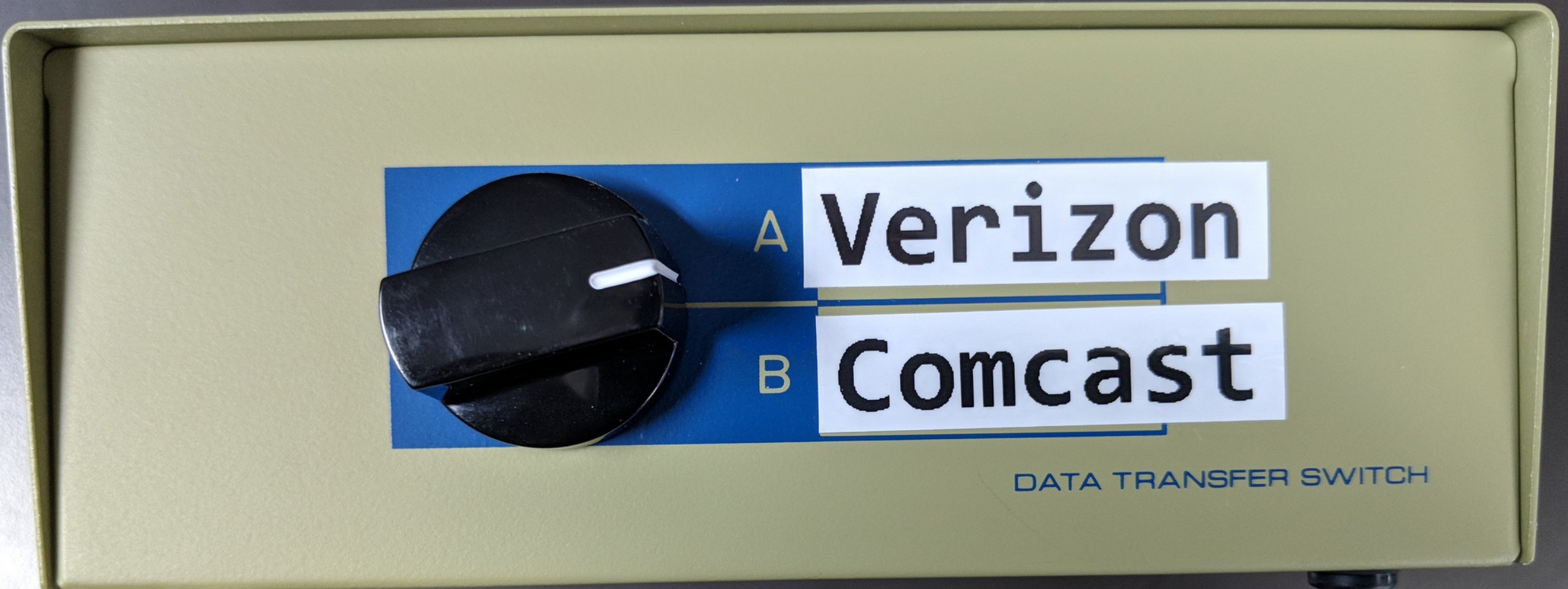
Information Service:
A Conflict of Interest
I use the French word, Télématique, because France took a lead when it deployed Minitel by putting computer terminals in all home as an alternative to phone books. The real draw was the ability to offer services.
It was a great success … for a while until the Internet.
In the US it was recognized that allowing the phone companies to get into the information services was a problem because there is an inherent conflict of interest in having the pipe provider also provide the services that use the pipe.
That was accepted in the 19th-century when the only business was services such as phone calls which relied on the network to connect a “dumb” microphone to a distant speaker. It made no sense to offer a raw pipe as a product. This began to change with the advent of data pipes. But it was still seen as a service of providing reliable paths (pipes) because the concept of best-efforts unreliable delivery didn’t make sense. Who would want an unreliable pipe.
By the 1970s the digital pipes made it easier for third parties to offer competing pipes because, unlike analog signals, it wasn’t necessary to have a single company control the complete path. This led to the divestiture of ATT based on a wholesale retail framing. It was assumed that the local pipe (phone wire) would connect to a long-distance provider of your choice. This didn’t work out but made arguable sense as long as digital was used in substitution mode for the analog signal. As I explain elsewhere, VoIP (Voice over IP) was a fundamentally different approach that made even the most basic telephone service entirely independent of pipes.
It was obvious that online services could be offered over the top of a generic pipe, so it was obvious that there is a conflict of interest in having the pipe owner. Thus, the effort to define what is an information service and what is not. Thus, online services such as Minitel were disallowed and so was the sale of computers and operating systems (Unix) that could use the network.
What was not obvious at the time was that video and phone calls were also services independent of the specific of a pipe. This is why it is so important to understand the new landscape in which we no longer even depend on a pipe.
Today 5G is an information service that bring this conflict of interest to the fore. Terms like Network Virtual Services and Software Defined Networking are nothing more than lipstick on the pig.
For that matter, in the age of streaming, why do we still tolerate and franchise cable companies and why do we have ISPs?
As an aside, in the 1970s ATT created 900 numbers with a billing model similar to Minitel based on the number called as if wall clock time was the only measure of value. The main use case turned out to be psychic hotlines and the like.
Another topic is the use of “minutes” as currency – the phone company as banker. The abuse of Caller-ID reminds us that identity is another service – one that phone companies do very badly but one we accept because if you can’t trust the phone company who can you trust?
Internet?
This takes us to the question of, “What is the Internet”. A strict definition is that the Internet consists of those systems directly connected using the Internet Protocol (IP). By that definition, home and corporate networks using NATs are apart from the rest of the Internet.
I see it differently but need a way to take about the larger concept of connectivity that isn’t tied to the particulates of the current implementation. That is what I think of as the Internet writ large. More in the section on a powerful idea.
Wi-Fi
Wi-Fi deserves special mention because, to many, it is the face of the Internet. At its simplest, Wi-Fi is just like Ethernet but without a wire.
(As an aside, Ethernet was modeled on the radio-packet work Aloha and is basically a radio network contained in a wire. The advantage is that it is not limited by the rules on open wireless, so it allows more innovation and use of the capacity).
But unlike Ethernet, where we can just plug in any device, we have to provide a network ID and a password to get a Wi-Fi connection. This is because today’s Internet is still an engineering prototype and is tied to the physical topology. The Ethernet has implicit physical security – if you have access to the physical wire, you have no restrictions (actually, there are some ways to impose rules, but that’s another topic and a kludge). This does mean that if you sneak a device onto the physical network, you have full access, but, shh, don’t tell anyone since we like the illusion, we are safe within our networks. And don’t tell anyone that the Ethernet signal can be detected outside the wire.
With Wi-Fi, we try to maintain this simple model of networking by having an ID that says which faux-physical network you are supposed to be part of. There is also a password so a passerby can’t plug in.
This looks a lot like the dial-up Internet with a need to log in. No wonder we accept it as the way it must be rather than seeing it as a result of the Internet being a tweener – caught between the physicality of traditional telecommunications and the abstractions of relationships independent of the path between. The path is very visible.
We then accept the idea that we must have a password for security and that encrypting Wi-Fi means we’re secure against interlopers. So naïve. It will get you a single hop, and then you must trust the rest of the path, which transmits the traffic further in the clear. The kid behind the counter can see everything. Fortunately, we are increasingly encrypting the entire path (as with HTTPS), which renders the hop-by-hop security of Wi-Fi moot.
Thus, we get guest Wi-Fi that is totally open but still has passwords that must be pasted on walls and use QR codes, even though such passwords are unnecessary since we’re not relying on them for trust. OK, we have the idea of stealing Wi-Fi like someone is like stealing light when they walk past your front porch. Admittedly, if you have artificial limits (byte caps) from a “provider, “you may be concerned, but this isn’t the case for commercial sites.
We also have the providers themselves (at least the cable companies in the US) offering open hotspots, including guest access on the cable modems they provide though they limit it to their subscribers because they are using a dysfunctional business model.
The good news is that once we get past this, Wi-Fi is a generic packet medium like Ethernet, which doesn’t second-guess what we are doing. (Sort of, but that’s a longer discussion).
Wi-FI is far better than protocols such as Bluetooth and Zigbee, which we’ll discuss below because it is an IP transport and is distinct from what we do with it. Bluetooth and Zigbee are what I call ball-of-wax protocols without the ability to separate out the elements.
Wi-Fi has its own issues as a first implementation. They include the restrictions of working within the constraints of spectrum allocations and the quirks of wireless signaling. When I’m speaking in the vernacular, I talk about Wi-Fi as the basis for packet-based wireless communications to keep things simple, but it’s just one implementation.
Wireless and Radios
Radios
Telegraphy worked very simply, opening and closing a circuit that could be used to produce long and short clicks at the very end. It is very fairly visible and easy to understand. The talking telegraph (the telephone) was a bit more complicated since it modulated the signal by varying the voltage, but it could easily be made visible by seeing how the vibrations move the surface of a speaker. Both were confined to a wire.
In the 19th century, experimenters discovered that changing electric currents generated fields that weren’t contained within the wire and would generate an electric signal in another wire. The word radio itself came from the word “radiate”. But it has also become associated with business models based on the limitations of radio broadcasting in the 1920s. Since the radio signal is not confined to a wire, it enables a single transmission to be picked up by any number of receivers. Point-to-point signaling was problematic using the technology of the 1920s because each relationship required a dedicated frequency band, and there were only so many available.
The use of the term “Radio” for the business of broadcasting music is similar to the confusion between the technology of the Internet and the Web as the most familiar use case. Again, we have the problem of using the vernacular because people understand it versus trying to talk about the technology itself. What makes this especially challenging is that many people don’t have the concept of an underlying technology independent of the particular use case. We also see this in conflating home automation with home networking. That’s why I started out talking about language but only hinted at the many sources of confusion.
The idea of frequency bands is very similar to how we use tuning forks. If you hit one tuning fork, another tuned to the same frequency will also resonate. You can fine-tune this by modulating the high-frequency radio wave with a signal corresponding to a sound wave, and you have broadcast radio, but it only works if no one else is transmitting on the same frequency. This was solved by having a Federal Radio Commission assign frequencies or, to put it another way, license speech. This was allowed despite the constitutional problems because it seemed necessary to avoid chaos. It was also a justification for creating the Federal Communications Commission, whose mission has crept into telling us which words are naughty and which are nice.
By turning frequency into property, we create a market for the scarce bands and stakeholders in the status quo.
One reason that I called Shannon’s use of the word “information” as being tragic is that it is often used to justify frequency allocation. But even if we accept frequency allocation, there are many ways to increase effective capacity.
Frequency allocation seems necessary to avoid interference. But interference is actually a problem caused by frequency allocations. Radio waves simply pass through each other. There is no concept of interference in physics – we just get confusion on the part of the receiver
That said, we aren’t limited to using radios for broadcast. We can have point-to-point conversations, but (without encryption) anyone can listen in. They can also jam the signal.
In World War II, Hedy LaMarr (yes, the actress) figured out that if you hop around by changing frequencies, you can avoid these problems, but I’m getting ahead of myself.
Cellular
One way to improve the effective capacity of the wireless space is to take advantage of an accidental property of Frequency Modulation [FM] in which a wrong signal would dominate the weaker one instead of becoming comingled by the receiver. This allows frequency bands to be reused in adjacent areas or cells. Hence the term cellular radio.
Early cellular phones didn’t work very well, but thanks to the “eh” protocol, they were able to fill a need, even if not for causal chatting. You could ask for clarification if the speech was garbled, and that is fine to arrange with your spouse and kids to meet at McDonald’s.
The next big advance was Personal Handy-phone and CDMA. PHP was meant for cordless handsets, but, perhaps thanks to digital technology, it worked far better than anyone could’ve expected, and it became the basis for digital cellular with far more capacity than the older analog systems. CDMA uses frequency hopping (thank you, Hedy?) rather than dedicated channels, thus increasing the effective capacity.
Those were fine for voice. Another standard, LTE (Long Term Evolution), was created to carry data that had less stringent requirements than voice. The idea was that 3G was for voice and LTE (4G) was for data. But VoIP changed all that we could build voice services on a packet (4G) network!
This also meant a convergence on a common infrastructure to the point that all the cellular companies are essentially identical and, to a larger extent, share a single physical infrastructure. Again, we have a fungible packet infrastructure. This time for wireless connectivity, but otherwise, it is the same as broadband and other paths.
Fungible Radios and Wires and Whatever
A packet is a packet. It does not matter if it is a radio packet over the air or a radio packet in a contained medium (fiber, copper, or Ethernet). We also have an inversion. It used to be that radio was good for long communications, and you’d use wires within your house. Today we’re increasingly seeing wireless as the preferred means within homes and offices because it is simpler, and the capacity is increasing (despite the limits imposed by frequency allocation).
For longer distances, we can hop on the nearest high-capacity links, such as fiber runs. In cellular, this is referred to as fiber backhaul because that’s how it looks through the legacy lens of telecommunications in which all traffic must pass through their network because that’s how it used to be.
Dial-up è Packets
In the traditional phone network, there was a wire running all the way from a central office to each telephone whether or not it was in use! This would be equivalent to assigning each car its own lane to go downtown to reach the highway or another home. We know how to share roads, and the Internet protocols are what allow us to share wires in the same way. Actually, far better because you have few options for managing automobile traffic, and each car is a larger physical object. With IP, we just throw away packets when there is congestion, and we do all this from outside the networking facilities! Furthermore, services like streaming take far less capacity than people think, and, despite advertisements, you don’t need more capacity for each lightbulb because that traffic doesn’t leave your home!
In the 1990s, there was a crisis as the modems clogged up the phone network because each point-to-point path to AOL and other dial-up services tied up a circuit! The system was out of capacity! The problem simply vanished once we shifted to shared connections, be it broadband or concentration at a central office.
The capacity vastly increased because we didn’t allow capacity to sit idle – a single phone line could now carry thousands of calls instead of sitting idle in case you picked up your phone. More importantly, with VoIP, the user decides how to use the available capacity rather than having busy circuits. If you have only a smidgen, you could just use text but still communicate, especially in life-or-death situations. People have died because they had cellular connectivity, but the carrier didn’t consider it good enough to allow them to use it.
In 1996 I proposed a very inexpensive way to convert phone lines to digital at DSL or better speeds. Rather than making promises, the gear at both ends could dynamically take advantage of what was available, and that would improve as the technology did. All those wires could be pooled so that you wouldn’t be limited to the capacity of a single wire.
It’s important to note that the online services started on dial-up and the value I got with a .0001-megabit connection was enough to create applications that drove the demand for more capacity. In a normal market, demand creates supply. My 1996 target of 1Mbps per connection would have been more than enough for the nascent dial-up Web. The effective capacity would have rapidly increased as we talk advantage of innovations such as pooling capacity and broadband coaxial connections were also increasingly available. People would’ve seen the value in investing in fiber and providing a wireless canopy to complement the wired connections.
Beyond Radios and Wires – Going Virtual
We can also exchange packets over existing networks, including existing packet networks. One technique is the VPN or Virtual Private Network. In fact, this is how the Internet happened by making better use of the available telecommunications network as packet infrastructure. But that shouldn’t be a surprise since we are already doing it with modems, but IP made far more effective use of the underlying facilities than traditional telecommunications providers did. More on this in the section on Layers vs. Resources.
This repurposing is also why home networks could share a single address yet become peers with the rest of the Internet by using creative workarounds for the limitations – the NAT itself being one. Purists decry the NAT, but the solution is to learn from it and make such distributed flexibility available as we move from engineering prototype to infrastructure.
Today’s Internet
Architecture and Elements
IP Packets
The key idea is that everything is converted to packets – be they text, images, streams or whatever. IP stands for Internet Protocol. The IP packet consists of a destination, a source IP address, the payload and control flags.
It is a starkly simple architecture – all you need to know is that you just put an address on the packet and send it on its way, and somehow, it gets to its destination. But you get no guarantee of delivery. If you care about lost packets, you can ask the destination site to send an acknowledgment. This is liberating in that the network itself isn’t trying to keep track of myriad streams of packets and can drop packets if there is congestion.
Applications can detect packet loss as a kind of backpressure and slow down transmitting them. It is the application, not the network, that decides how best to respond to such limitations because the network can’t know what is important to each application.
IP Addresses
The IPv4 Address
The original IPv4 (version 4) address was a 32-bit number with two parts – a WAN (Wide Area Network) and LAN (Local Area Network) address. The number of bits allocated to the two parts (WAN/LAN) varies. A typical split is known as “/24,” with 24 bits for the WAN number that identifies each network and 8 bits for the local portion. (It used to be called a class C network).
To simply connect to another device, all you need to know is its V4 address. You don’t have to know how many bits are in the WAN and LAN portion. It’s just a 32-bit number. This is starkly simple.
We don’t have to think about “which network”. Instead of thinking in terms of pipes, we can focus on the relationship between the two endpoints.
The important point is that this is architectural simplicity. Even if the underlying reality is more complicated, we avoid getting entangled with that complexity.
We’ll explore this architectural issue more below.
We should treat all the accidental aspects of IP addresses as irrelevant for day-to-day use. That’s part of the magic of the Internet.
Read the rest of this section only if you want a deeper understanding!
NATS
There are a limited number of IP 4 addresses – 32 bits isn’t enough to assign each PC its own address. The providers thought of an IP address just like a phone number and wanted to charge a monthly fee for each one.
As an aside, as we noted, each phone required a dedicated wire whether or not it was in use, and each one had a number assigned – the phone number. It seemed to make so much sense that we even pay for a phone number on VoIP lines when there are no resources consumed and the phone call is an app!
The NAT enables a local network to share a single IP address by treating the local network as a single machine with one address. Inside the local network, the NAT provides addresses like the familiar 192.168.x with 256 available local addresses or uses 172.20 or 10 prefixed when more are needed.
Those addresses are not visible to the outside world, but you can forward connections by mapping port numbers into local addresses as subaddresses. For example, port 25 is typically an email server. You can then say machine 192.168.1.4 is your email server and forward those connections to that machine. (Note that 25 is typically blocked to prevent spam).
The task of maintaining a relationship between machines on the LAN and the wider world is messy. I looked forward to IPv6, but our ability to program around the limitations shows the power of the Internet architecture. Devices can tunnel through the NAT to maintain their own connections with other systems.
This is also another reason why perimeter security is problematic. The NATs are one reason we’ve kept perimeter security.
PCs assumed they were safe from the world on their local networks or when dialing up. Interconnecting them with the rest of the world was a major security threat because they became visible to the entire world. The accidental property of shielding them from view became a feature in the guise of the firewall. That’s OK as a stopgap measure, but rather than using it to provide breathing space to research better protocols, it became institutionalized as a feature.
The accidental property of being invisible to the wider world allowed for interconnecting PCs and home networks to the world. Not only was I planning for NATs to evolve to be V6 routers. I also planned to only accept encrypted connections.
Alas...
IPv6
The 32-bit address was adopted for the engineering prototype. A longer address would have been more expensive in the 1970s. The problem is that that prototype became today’s Internet, and 32 bits isn’t enough for over four billion endpoints.
The solution is the 128-bit V6 address which still maintains a WAN/LAN distinction. The V6 address has a special LAN-Local address that works among devices on the same local network and uses the Ethernet address as an identifier. This is very useful because it provides a stable endpoint identifier
So why hasn’t v6 caught on? I claim there are two reasons.
Our ability to program around the limitations of IPv4 greatly reduced the pressure for adopting v6.
But there was also the idea that we’d transition to V6, and that transition was the opposite of the way the Internet was adopted, starting locally (AKA the edge) using preexisting facilities (dial-up and then broadband). The plan was to have V6 implemented by the carriers. I argue that this was a recipe for failure. When doing home networking, my plan was to convert NATs to V6 routers going over IPv4, if necessary, so that programmers would assume an IPv6 address. That didn’t happen; the carriers have been very slow to roll V6 out. Provisioning a router for V6 isn’t always automatic, which means it’s not ready for consumers.
V6 is still important and useful because it allows a cellular carrier to assign an IPv6 address to each phone. But those carriers don’t try to play nice with V4 applications for wide-area use. Again, we can program around it.
DNS – Domain Naming System
How does one find the IP address of the other endpoint? The solution is a simple database that takes a key and returns the corresponding record type. If I ask “Micky-A,” will get the A (Address) record in the DNS table (zone file). For an address like office.Frankston.com I can specify a zone file in the “.com” zone file I own. I can then continue the path to subdomains or enter “Franskton.com” directly.
This made sense in the early days when the Internet interconnected research computers. Today that idea has become fatally flawed. Imagine if you lost all your social security benefits if your name changed! That’s why you have an SSN (or similar identification number in other countries) rather than use your name.
If the DNS used GUIDs (Globally or Universally Unique Identifiers) just like databases do, then there would be no need for them to expire everywhere, so the names could be resolved. And we could then use trademark law to avoid confusion rather than allowing both Rolex and Rollecks to trap the unwary. But that’s a longer conversion.
For now, you use the DNS to translate names into IP addresses.
VPNs
A Virtual Private Network is an address independent of the underlying protocol. There are many ways to use the mechanism of the IP address in creative ways. In a sense, it’s like putting one letter inside another so that you can have it relayed to a destination other than the one in the outer wrapper. It can be used for encrypted tunnels, pretending you’re in a different location or for virtual communities independent of the underlying topology.
Dynamic and Static IP addresses
IP addresses predated the DNS. Initially, they were assigned manually – both the WAN and LAN part. The WAN part of the address can change any time a provider reconfigures its network.
Various protocols (BOOTP, DHCP) were devised to automatically assign the addresses so you could plug in a computer and have it “just work.
Unfortunately, from my point of view, IP addresses are still too visible. In many cases, network engineers carefully assign IP addresses. In doing so, they add complexity and fragility.
In many cases, people assign IP addresses carefully to manage and isolate network traffic. As I see it, this loses the key simplicity of separating the transport from the application and adds unnecessary complexity.
We need to see any use of static addresses as a bug.
TCP
Transmission Control Protocol is used to provide reliable streams on the Internet. It was designed while we were learning about connectivity, so it was seen as a fundamental protocol along with UDP. Today protocols like QUIC play a similar role but are built using UDP. This is why I write “TCP” and “IP” separately to make it clear they are different kinds of protocols.
The genius of TCP is that it allows the equivalent of network management in the endpoints by having them adapt to network conditions dynamically. When the network lies (as in buffering packets when there is congestion rather than dropping them), we get effects such as buffer bloat, which break the protocol. The overall lesson is that having the network second-guess the applications makes it difficult to innovate outside incremental improvements of what we have.
Even today, we’ve got an Internet that works for the Web but does not work for devices. Hence the idea of a separate Internet of Things. It’s more a reflection of the engineering compromises of the current implementation rather than a problem with the powerful idea of decoupling relationships from the path.
The Web, Email, MQTT etc.
These aren’t fundamental in the sense that IP is. They are ways of using the underlying connectivity. This is why the Web Consortium is totally apart from the Internet engineering effort.
As an FYI, the HTTP in a web address stands for Hyper Text Transfer Protocol. It’s simply a message format used to specify the protocol to use to request the web page using TCP (or a similar protocol). There are other monikers, such as FTP, TEL and MAIL, for other web protocols. The content of the response is in HTML – Hyper Text Markup Language.
The important point is the stark simplicity of these protocols.
A Powerful Idea and a New Paradigm
As mentioned above, packet networks like ALOHAnet forced us to think outside the network because there was no provider to assure reliable delivery. This freed us to rethink the very idea of networking from first principles, and we went back to the idea of a network more like a social network – cooperating systems – rather than something a provider provides.
I remember my own reaction when Bob Metcalfe described his class project, the Ethernet. It ran at 2.994Mbps when the normal network speed was 9600bps, and a high-speed connection was 56Kbps. To get his Doctoral Thesis to be accepted, he had to show his network could perform by legacy measures of efficiency.
I saw it very differently. Even if it ran at 10% of the promised bit rate, it was far better than the networks of its time.
As an aside, when speaking casually, I’ll use the term “speed” for the bit rate, but if we’re speaking strictly, the bits are all going at the speed of the electrons, but we have more symbols per second, yielding higher capacity.
The Ethernet is a contained radio medium and creates the opportunity for innovation in how we use it. One simple use is to transfer files as a stream of bytes. The receiver would send an acknowledgment for each packet, and the sender would retransmit if the acknowledgment wasn’t received. It didn’t matter if that was because the original packet got lost or because the acknowledgment got lost.
Over time we’ve moved beyond this simple algorithm to allow packets to be sent out of order and to adopt strategies such as better never than late. The latter could do streaming by using the intelligence in both ends to fill in the blanks or to use what is available as in reducing the resolution of the video while keeping the stream doing. That’s why Netflix could work even at very low bit rates.
Meaningless!
The very powerful idea here is to use a collection of bits (packets) as our building block. They have no inherent meaning, meaning they are a Tabula Rosa.
The idea that bits have no intrinsic meaning should be obvious, yet we are taught engineering in terms of layers. It’s a concept I compare to the cliché – Turtles All the way Down. Layering is a dependency model in which anything we build is dependent upon lower abstractions. This seems to make sense, with voice being done on top of a reliable telecommunications network. This is a fundamental concept. Think about a hydrogen atom – how can it know if it’s part of a water molecule.
The Internet is so transformational because it inverts the layered dependency and uses a resource model instead. The meaning comes from context! Take an HTML document – it doesn’t matter if it uses IP or is stored in a file. It uses those means as resources and is not dependent upon any particular transport.
But the idea is far more powerful because we don’t depend on a reliable transport. We have to program around the limitations of the transport.
But far more important is that we are free to change the problem we are trying to solve! The ability to redefine the problem is key.
As I wrote in https://rmf.vc/esf, this is fundamental to the nature of how systems evolve by repurposing what is available and taking advantage of opportunities rather than being constrained by the past. I often use the example of the ear evolving from the jawbone’s ability to detect vibration and then building on the capability. It is not something that could have been anticipated.
In communicating, if we can’t do audio, then we can use text. We may have situations in which text is not sufficient. Then we’d need to accept that limitation.
If you think about a packet on an Ethernet – there is no context. The owner of the coaxial cable just sees a packet and can’t guess what it means. Perhaps if it’s clear text, one might be able to read a snippet out of context, but even then, there is no context. And encrypted packets, each taking a different path, frustrates such efforts.
This is where the term “best-efforts” comes into play. In transitional networking-as-a-service, we presume reliable delivery. This isn’t possible if we know nothing about the context. It may be possible to buffer a packet and use the retry algorithm, but this has several problems. One is that it duplicates what the application is doing, and if there are multiple layers, then that is repeated for each layer. And it may be for naught since a streaming application can’t wait for delivery, and any effort at assuring reliable delivery would create delays.
Another reason is that buffering inside the network creates a false indicator of capacity so that TCP and related algorithms cannot share the capacity and adapt to the actual conditions on the network.
It’s worth mentioning the ISO stack, which is widely taught in networking classes. It’s meant to be a model, but it is on the assumption of a layered world, but the model doesn’t apply to our current understanding of connectivity. How does layering apply, for example, to a VPN which uses the entire stack as a resource or to HTM, which is a transport for content itself … which leads us to?
Bits vs. Electrons, Ideas vs. Things
We don’t send things over the Internet – we send references such as URLs. Here too, the technology gives us a way to be explicit about sending references, not things, but this is the way language works – words aren’t things. They can be used to share things. Language is more than nouns, and things aren’t just references to physical objects. They can be used to share thoughts about things that don’t exist or be incomplete, as in je ne sais qua – I don’t know or can’t articulate an understanding. It can also be inherently ambiguous such as the terms I used above. They allow us to have a complete conversation without any shared understanding.
Here too, we need to be careful about the concept of “bits” because they can be used as measures. Thus, when Claude Shannon used the term “bits”, he wasn’t talking about how much knowledge could be exchanged. It’s akin to talking about a 1-inch pipe without saying what the content is. In this case, that 1-inch pipe is not necessarily 2.54 cm since by saying 1 rather than 1.00, we are signaling low precision, so 2½ is more correct. Or is it – who knows, and most of the time, you don’t care.
Another abstraction is money. We can do precise calculations of money in accounts, but that says little about the value of the money and what it can buy. A simple example is the airline mile which may have a nominal value of one penny ($0.01), but the actual value depends on how we use it since it can be used to buy a ticket at $0.10 point, and the value is also different to different people depending on where they travel.
This wreaks havoc on any simplistic policies which presume they could charge for the intrinsic value of a bit and the carrying capacity of a pipe. That’s not the way it works.
First, as we’ve seen with the Ethernet, there is no relationship between the application and the packets of bits. Notice here that the word bit is being used as a concrete measure on the wire, but that has nothing to do with the bits we use as a representation. A streaming movie may use no bits on the wire, or it may use a terabit. An image may be complex but can be described in a single word like “New York City”.
This is why we can ship a truck across the country by just sending the part number since we don’t care which truck it is – we just care about the model number. And if we accept that, we gain immensely over the cost and complexity of shipping a specific truck.
It also allows teleportation. Not the dumb version in Star Trek that assumes we need to ship turtles all the way down to create an exact copy but the smart kind that simply describes how to create the object out of pieces available at the destination and what properties are salient, and which ones don’t matter. The more we are indifferent to the details, the less difficult the task is.
This is not just about the Internet – it’s about the fundamental nature of our shared reality. The Internet is a laboratory for understanding this. Software and our ability to exchange concepts (sending messages makes this possible).
This just touches on the rich set of concepts, such as binding, in which we accomplish tasks by just changing relationships. If I bind “dump truck” to a fungible class of truck. I can move the truck just by binding a name.
A website such as Wikipedia isn’t in just one place – you bind the name to a convenient copy. And you aren’t even sending that copy – just a reference which, being a name, can then be bound to any other instance.
If you’re feeling unmoored – get used to it.
More at https://rmf.vc/InternetNativePolicies.
Very simple – the Internet is not a series of pipes in the sense that content flows through them. Instead, we use any available path.
Why did IP win over Intelligent networks
Looking back, it wasn’t even a contest. And we’re going to see the same thing again with the attempt to resurrect the idea of an intelligent network with 5G.
The Intelligent Networks limited opportunity because they were designed to be transports for an enumerated slate of applications that required reserve paths with guaranteed capacity.
The IP approach made no promises but created unlimited opportunity for those who could take advantage of those opportunities. At first, it didn’t seem to be a contest as the Internet’s low performance and high latency made it unsuitable for vital applications such as voice and video and for the reliable transfer of large amounts of data.
Over time a virtual cycle played out.
Aside: A Virtuous Cycle is the cousin of Moore’s Law. It plays out as each modest effort creates opportunity for the next cycle. We see this with the Web as simple protocols created enough value for people to incrementally add capabilities. The biggest impact, however, may have been indirect as the demand for capacity for the Web created the opportunity for voice and video to work.
Demand creates supply. Simple applications create a demand which creates capacity for unanticipated innovation.
Opportunity is hard to understand because, in itself, it is useless. It is the unknowable context that makes something of it. This is not entirely true since the opportunity is usually created with some use cases in mind. To those used to networks, it was obvious that there was value in enabling the transport of packets, and those used to writing software could see how to program around the limits by retrying till the packets got through. (TCP and, later, ALOHAnet) But we didn’t necessarily foresee how well that could work. In the early days of the Internet, many saw IP as a placeholder will the official protocols – the ISO stack – would be implemented.
The story of VoIP is telling in that it was originally intended (by VocalTec) for use on the local network where there was sufficient capacity. They hadn’t anticipated that a byproduct of the capacity created for the Web, that that algorithm would work over the wider Internet.
ATM (Asynchronous Transfer Mode) is the packet protocol of traditional telecommunications networks. It uses a series of small packets to provide a digital path that emulates the analog circuits, including guarantees – SLAs (Service Level Agreements), which are basically promises to reserve capacity at a price. That works fine for a single hop – you can simply reserve capacity. But it becomes more complicated when setting up a circuit through many hops when the goal is to maximize utilization on the assumption that the networking gear is very expensive.
That’s one problem – the cost of making those promises is high, and even when there is no traffic, the capacity is still reserved. This is complex and requires a lot of capacity in itself. And all of that is expensive, and even then, it never really worked across carriers because any slight variation in the protocol and approach created a mismatch. This was hidden by using old-style analog connections to handle the mismatch!
If there was no available capacity, there was no opportunity for the users to innovate.
The approach was also fatal for video since charging for capacity meant that video, which required more capacity, was much more expensive than voice!
Yet today, we assume high-quality video thanks to the virtuous cycle. It has caught on because there is no premium for video since it doesn’t rely on favors from the network. Decoupling the meaning from the packet forced innovation because you can’t pay for special treatment!
Putting intelligence in the network means the network itself captures the value. This biases engineering to align with the business model of network ownership and control. As intelligence (another anthropomorphic term for mindless computing) shifted to the devices outside the network, the value left the network.
Note that I am trying hard to avoid the term “edge” since that assumes there is a well-defined boundary for a network; indeed, that was the reality with networking-as-a-service (AKA, reliable pipes). If networking is something we do in our apps, then there is no edge. We’re talking about relationships between endpoints. Those endpoints may be applications within a computer, which might migrate from one computer to another. Or, as in the case of a NAT, a whole complex of computers may be considered a single system.
The concept of systems is a topic in its own right – a group of lights used to light up a room is a single source in terms of someone who just wants light but a group of bulbs to those who look closely. And those bulbs might not even know they are part of a light source that might also include the opening of shades to let in sunlight.
As we shift from a network provider using the network as a cost center to sell services to those services becoming applications, we get an inherent conflict of interest. If the value is no longer going to the network owner, then there is a serious problem in funding the network as a cost center. We’ll get into that more in the discussion of the public packet infrastructure.
IP won because it was simple, and VoIP was the inflection point by removing any necessity for a networking-as-a-service in the sense of making promises. In fact, those promises weren’t even real since there was a 100% failure rate when the capacity got allocated to the highest bidders.
A good illustration is the concept of call complete. In the 1970s, 90% (or much more) of the calls completed, but all that meant was that the other phone rang. It did mean you reached a person! The real completion rate was more like 40%, and even that was only because fewer women worked. You couldn’t install your own answering machine though you could pay for a business service to take messages. Once the Carterfone decision said people could hook up their devices, they immediately bought answering machines.
Another aside. One reason the phone companies lost control is that the analog two-wire (red/green) interface was simple. Anyone could connect a device. The phone companies complained that the device could harm the network, but that made no sense since, at most, they could burn out a single board. The analog interface was better than the digital faux analog, which allowed the network to second-guess the packets.
ISDN, the initial digital network, was a disaster. Not only did it bring back per-minute charging, but it was also far more complex than red/green and didn’t allow people to have multiple devices without special hardware and software!
It is important to note that the concept of services extended to the phone company’s ownership of the instrument (AKA the phone) since the microphone and speaker were an essential part of the service. In the Hush-a-Phone case, the phone companies even argued that putting a box around the phone harmed the quality of their service!
Too bad today’s Supreme Court seems hostile to innovation. An earlier court ruled that using a videotape to record a program was allowed, but the recent court ruled against Aereo doing that for you! No wonder the court is willing to abide by the idea of radio frequencies as property.
5G!
Considering the woes besetting the phone companies (and cable companies) as their business models collapse. It makes sense to be nostalgic for the good old days and to bet against innovation. The latest ploy is the anti-Internet – 5G. 5G is sold as high capacity and low latency cellular, but the same radios can work with Wi-Fi, so it’s not that special
The real goal is to claw value back into the network by claiming that they will provide guarantees such as low latency and reliable delivery – these very promises can’t be made because allocating capacity to make those promises creates scarcity that the users can’t get around (except by buying preferences) and guarantees of low latency doing’ scale. 5G becomes a brittle point of failure and is positioned as a premium service. But, as we saw with VoIP and video, it would be foolish to pay a carrier for what we can program around.
5G has other problems, such as being designed for surveillance and control – the authoritarian’s dream, which is supposed to put an end to all the disruptive innovation.
Alas, it is sold as the natural evolution of cellular – another innovation whose time has come and is now living on the fumes of past glory.
Need to explain SMTP, history and relaying. And X.400.
The FCC and PTTs … and a reboot
The Federal Communications Commission in the US and related organizations worldwide were created to assure our vital need for a communications infrastructure. They are products of their time, modeled on the systems used to regulate the shipping industry, such as the Intestate Commerce Commission (according to the FCC itself).
As Richard White explained in Railroad, the business model of long-haul railroads in the US west had a problem of high capital costs and little ability to differentiate themselves. The solution – regulation – was welcomed by railroads because it helped make their business viable.
The telecommunications industry had a similar problem with phone calls being a commodity. There was little opportunity for differentiation and a high cost for redundancy. A phone call is a phone call is a phone call. The solution was managed competition which often devolved.
The Federal Communications Commission was created to bring order and stability to the marketplace, with ATT acting, in effect, as a quasi-private government agency. The authority to regulate communications was inherited from its predecessor – the Federal Radio Commission. As I noted, spectrum allocation was deemed necessary to bring order to the wireless space. The dumb endpoints were entirely reliant on a smart network. Today those endpoints are not dumb, and we don’t need such regulation.
We see the consequences in today’s broadband. In many cities, there are multiple providers offering identical services. That was problematic enough. There was some differentiation in the content offerings, but today it makes far less sense since all packet media are the same, and each one can serve an entire city.
A normal market would not be able to sustain multiple dumb pipes. How many cities have redundant electric grids? But, unlike electricity, we don’t need the artifact of pipes, and, unlike electricity, there is no intrinsic cost. Yet we tolerate today’s business model because of the analogy with electric grids and with the idea that bits are fluids that flow through pipes.
And there is the collateral damage of creating scarcity because we’ve taken an abundant commons and fenced it off into narrow pipes and then have partitioned off the wireless access outside our homes and, unlike the shared pipes into our homes, we charge for each device as if it were 1934 and we needed a wire for each phone whether or not it is in use.
The ICC faded away and was replaced by a Department of Transportation (DOT). The FCC must be replaced by a Department of Connectivity to assist cities with supporting connectivity.
As I explain in Public Packet Infrastructure, a packet infrastructure is the only rational model when value is in the whole, and it would create huge opportunity. It costs absolutely nothing (OK, a smidgen) compared with streets and other infrastructure yet creates unimaginable value. Remember, we couldn’t have imagined the value created by the Web, and a PPI has far more potential because it allows us to rethink our physical world, deliver new services, including connected healthcare and save a lot of money over today’s lease but never own model. It also removes the very concept of affordability which drives a digital divide and so much more.
Building on the Ideas
How do we act on this understanding?
Old School
Today each problem seems to demand its own infrastructure to meet its particular needs. Not only does this approach have a high cost and little synergy, one doesn’t even know whether the system will work until a lot of money has been spent.
One example is the idea of a separate system for public safety. It seems like a good idea, but it shows all the failures of the intelligent network. The idea is that in an emergency, we need to give absolute priority to public safety. But this doesn’t work because, in an emergency, we need to be able to use all of the capacity and opportunities. We can’t limit ourselves to special (and very expensive) public safety gear and designated public safety personnel. We saw this failure on 9/11 when police and fire department systems could not interoperate.
In the 1950s, the Department of Defense saw the need for a road system that could support military operations. Rather than building a separate system, they assured the public Internet Defense Highway System (to use its original name) was capable of meeting their needs while being shared with the public.
A separate public safety system has myriad other problems, including limited capacity. Reserved a 10 megahertz band seemed like a good a few decades ago but now falls behind what is considered minimal for home use.
Architecture and Ambient Connectivity™
The key is to factor our designs so that we can focus on the problem at hand and take advantage of opportunities. Separately we can provide general resources for all purposes. This is architectural thinking.
I coined the term Ambient Connectivity™ for this concept. I put in the ™ in an effort to keep the term meaning intact. Very simple when you build a system, you should be able to assume connectivity and focus on the relationship between endpoints and systems of devices. Separately we can assure that the infrastructure is available.
This is not a new idea – we don’t expect a car manufacturer to build its own road system.
The key is to accept the limits on control – we can’t guarantee availability or performance. In return, we get abundance and freedom to innovate. The value of applications drives investment in the shared infrastructure as it has with roads, water and other vital facilities.
We also need to teach resource-based engineering and view layered as a heuristic that comes with limitations and caveats.
While we wait for open infrastructure, we can implement necessary shims. Apps on PCs and our devices assume someone is there to pay for an account in the current telecommunications environment. This creates a problem for medical devices, education and more because we can’t assume connectivity.
As I wrote in https://rmf.vc/IEEEBetaLife, today’s Internet protocols give us a taste of what is possible but need tweaking to act as infrastructure. Fortunately, the very nature of best-efforts connectivity allows us to put in shims since we can tolerate such intermediaries. A bigger problem comes from second-guessers such as firewalls.
The Public Packet Infrastructure
The Public Packet Infrastructure is my term for the open infrastructure that supports ambient connectivity. One of the goals of this essay is to help people understand the value and implementation of such an infrastructure. You can fall back on our current methods when a PPI is unavailable.
Amazon’s Sidewalk is an example of an intermediate approach. If you have an account, you can use Sidewalk as infrastructure and Amazon is dedicated to building it out. Other approaches include LoraWAN. These are useful examples that will help move us toward public infrastructure.
Today cloud providers are limited by third parties in the path. A connected pill bottle is a very simple idea and can be implemented at a very low cost if we can assume connectivity, but today, the cost of negotiating and justifying the cost of each transaction has limited the availability of this simple capability. Amazon’s Sidewalk is one example of a cloud provider taking the initiative. The key is to create a shared open infrastructure as an enabler that will create trillions of dollars in value for society and billions for the cloud providers as stakeholders.
Further Reading
My Writings
I have a list of readings at Further Readings though, as with all else, it is an incomplete-work-in-progress.
Refactoring Consumer Electronics was my first column. In it
Others’
ASDasd
In-Progress
The next sections are notes.
I’m including these here to share the thoughts-in-progress and elicit more feedback.
New Concepts
Looking further ahead, we need to understand the new concepts, such as meaning coming from context and the importance of binding and linkages (such as GUIDs) that have no inherent semantics, thus enabling applications to use them as resources rather than dependencies. (Layers again). That’s a whole book in itself.
Why Best Efforts Won!
To be written
Longer Snippets
Cellular 🡺 PPI
Written in response to this FB Post.
Steve Atlas, thanks for the pointer to the audio. I skimmed it, and it is a very strong case for an Internet-style public packet infrastructure.
The design point of the current telecommunications system is failure. Just listening to Harold Feld describe the path of a call is, as a systems designer, painful. Sure, in the 1870s, it was necessary because we connected two dumb endpoints and need to keep the waveform intact (like keeping the string taught between two tin cans). Any failure is fatal.
Today we know better; with VoIP, we can communicate if any path is available and, typically, get video for free. In fact, the dirty secret of telecom is that it is indeed going over packets -- that is the reason we use a data network, LTE, which wasn't meant for voice. 3G was supposed to stay around for voice.
A public packet infrastructure eliminates spectrum scarcity just like it did for wired connections. I need to remind people that in the 1990s, the phone system was collapsing because all the long-hold time calls to AOL were clogging the system. By converting those calls to a best-efforts packet medium that scarcity disappeared. We no longer had to have a line to every phone on-hook or off-hook. (Those terms themselves are a legacy of the old model in which a phone off-hook held resources even when no one was talking!).
And we can then honor the US first amendment by getting rid of the need to license radios -- we'd just need rules about not frying your neighbor and not blinding telescopes etc. Low power USB wouldn't need to ask permission (and cosmic rays would no longer be in violation of the law). The licensing thing was based on 1920s-era tuning forks as the design point).
Another big advantage of a PPI is that communities don't have to grovel before the FCC to convince them that coverage maps are bogus. They can implement their own connectivity using any technology available and mix them. Unlike today when broadband subsidies are necessary because the business model of telephony doesn't work in an app world, helping disadvantaged communities is positive public policy. Any subsidies go to the community and not a carpet-bagging telecom.
ARPoo indeed! (Sorry, couldn't resist.). ICC=>DoT, FCC=>DoC (Department of Connectivity) because the PPI is a market in balance.
I'm working on an essay, more like a book, to explain these concepts -- https://rmf.vc/InternetConcepts but, with ADHD, it's slow going, so any feedback is appreciated as I try to explain these concepts (again and again because it's so important). https://rmf.vc/CIPPI for more on the PPI.
One more point -- wired vs. wireless is not the issue. That's a local engineering decision. The FCC shows how little it understandings about how speech works by insisting that wired and wireless words are inherently different because Maxwell's daemon rules!
Origins Of Telecommunications
Notes
- Loose history – others go into far more detail.
- Going back to runners and scribes and the postal system. Messages as freight
- Napoleon’s signaling system
- Telegraphy and the Victorian Internet
- Charging for words
- Codes disallowed
- The talking telegraph
- High capital costs and limited differentiation
- Frequency allocation and pipes
- Television and another system
- Modems and repurposing
- Early fax and telex and teletypes
- The ICC and the FCC
Personal and Other Computing
- Concepts
- Users and login
- File Systems
- Networks and networking
- Telecom history
- Napoleon
- Software and von Neuman machines
- Philosophical implications
Scratching the Surface
Despite the length of this essay, I’ve barely scratched the surface of the new (and old) concepts we need to understand in order to enable the future by creating opportunity. As the great Pogo said, we have met the enemy, and it is us. We can choose to stick and stay in the past, be limited by old ideas and metaphors, or create opportunity and enable a future.
These are brief notes that a worth expanding on or, more to the point, deserve their own essays. I’m including them here so at least they can have some exposure.
The concept offline/online [2023-09-25]
I was just setting up an email and it wanted me to set up what happens when I’m offline. I can understand what it means to be unable to connect to a given email server but when there are multiple servers, I might be able to connect to some but not others.
Here too we have an echo of the days of on-hook/off-hook inherited from the days of dedicated phones that only worked when connected to the central office and which kept a line in use. A similar dichotomy existed in the days of dialup computing – your terminal was nothing when offline (disconnected).
This no longer makes any sense when we have peer connectivity among devices. If my wall controller can turn on a light but not reach a website with the weather, is it online or offline? I have a community server I can reach but can’t got to distance service am I online or offline.
We terms more suitable to a more distributed world independent of the accidental properties of the underlying topology.
Notes
Word List
This is a list of words II plan to use.
- Efficiency?
- Architecture and ambient connectivity
- Origin of Ethernet
- DECT and other protocols
- Bluetooth and Matter and CEBus etc.’
- Home automation
- Bits vs. Electrons
- Carry wisdom outside the pipe/
- Math – describing reality or is reality
- Deep dive
- Software
- DNS and GUIDs
- More about tooling and stability
- Addressing and naming
- Web
- Routing vs. meshing vs.
- Programming vs. Coding
- Ambient connectivity.
- The tragedy of the commons and other stories to scare children and Fox viewers.
- Managed Innovation
- Layers
- Naming and Addressing
- SSID and the DNS
- Don’t change that dial
- Common Carriage
- VLAN and subnets, VPNs
- Bluetooth, home automation, GUIDs
- The problem with certificates
- Single points of failure
- Cellular
- 5G, why just wireless and all that
New words and concepts
- Binding
- GUID (or UUIDs) and meaning
- Efficiency guarantees and latency. Self-insurance and eh
- Logging into the Internet and the whole interception business.
Beyond
- Neuroscience
- Where meaning comes from
Home Automation
- As one of many use cases
- Points of dependencies vs. relationship
Other notes
- Mobile sharing
- Peer, advertising and all that.
- USB
- Spreadspectrum
- FCC and managed markets
- Amazon Sidewalk
- Wholes vs parrts