


Preface
Sometimes the problem is not in the answer but in the question that we forgot we were asking. In 1876 Alexander Graham Bell wanted to improve people’s ability to communicate over distance.
I wrote this essay for a celebration of the 150th anniversary of Bell’s invention and, indeed, it is an event worth celebrating. What I was struck by in the presentations was the absence of the spirit of invention. I’d like to think that he would revel in the new possibilities of the age of intelligence in our devices and our understanding that communications is about the exchange of ideas and relaying vibrating airwaves over a distance using electronics.
The modern term telecommunications emerged in 1932, adapted from the French word télécommunication, to describe the growing family of technologies capable of transmitting information over long distances. Before this point, communication systems were discussed in narrow, separate categories—telegraphy for electrical signaling, telephony for voice transmission, and wireless for radio. As these systems converged and international standards bodies sought unified terminology, a broader concept became necessary. The new term combined the Greek tele (“far, at a distance”) with communication, capturing the shift from singlepurpose devices to an integrated infrastructure for transmitting signals, speech, and data across vast distances.
The problem is that relaying speech is a means of communicating but not an end in itself. That’s the way language works, it’s why we still dial phones, and we film people using our smart devices. These are harmless uses of fossil words but the confusion between the word for the technology we use to communicate, and the concept of communicating has trapped us in the past. I’ve compared it to paying people based on ergs, the measure of work in physics rather than the value of their labors.
Confusion persists because, on the surface, nothing has changed. We still speak to each other at a distance using voice using the existing telecommunications infrastructure with the Internet using that telecommunications infrastructure as a facility. That didn’t matter much as long as we needed a separate system for the exacting demands of speech. This all changed once we no longer need a specialized trillion-dollar telecommunications network and no longer depend on providers. Telephone calls are now implemented as an application on our devices. Not only that, but they also aren’t limited to voice or any provided services.
Voice is now over IP and the concept of telecommunications exists only as a ghost of the past. In this essay I explain how everything has changed and why even as, on the surface, nothing has changed.
The real story is much deeper and more fundamental as I will explain in another essay about the fundamental shift from relationships maintained by a third party (as in a phone call) and relationships that are independent of whatever is between.
For now, the key point is that we need to go back to the problem Alexander Graham Bell was trying to solve – improving our ability to communicate – with our modern understanding of what it means to communicate and our means of realizing that goal.
Overview
The 150th anniversary of the invention of the telephone is a time to reflect upon the era of telephony. It was an amazing feat in 1876, and, for nearly 100 years, it defined how we communicated. And we still do, or so it seems. The reality is quite different and that difference is central to public policy.
The story of the transition from circuit-based telephony to today’s connectivity is a fascinating story of people and ideas, but first, a technical overview. The key to the story is understanding that the best way to honor Bell’s memory is to move on to connectivity as infrastructure rather than being hostage to the design point of 1876.

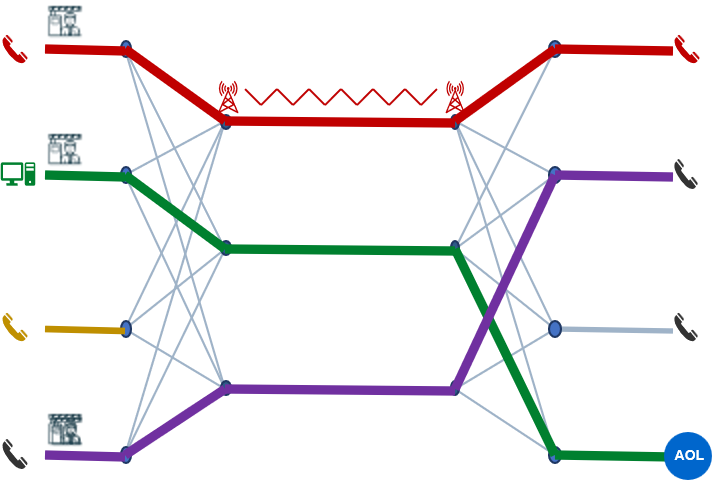
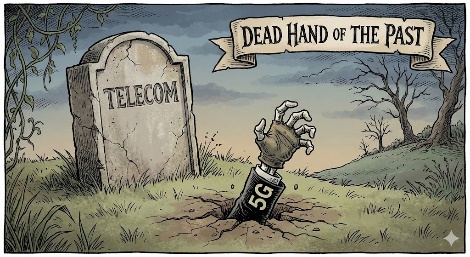
Even when Claude Shannon digitized the voice we still needed intelligence in the network to assure the isochronous delivery necessary for dumb endpoints. The key point is that each connection occupied a pipe. That usage had to be metered—in effect putting a tollbooth at the entry to each pipe. Pipes are also rivalrous and once the capacity is doled out, you can’t get an additional connection. AOL users used modems to repurpose the voice connection thus clogging the pipes for extended periods. Alas, this idea of taking capacity off the table is back as a “feature” of 5G.
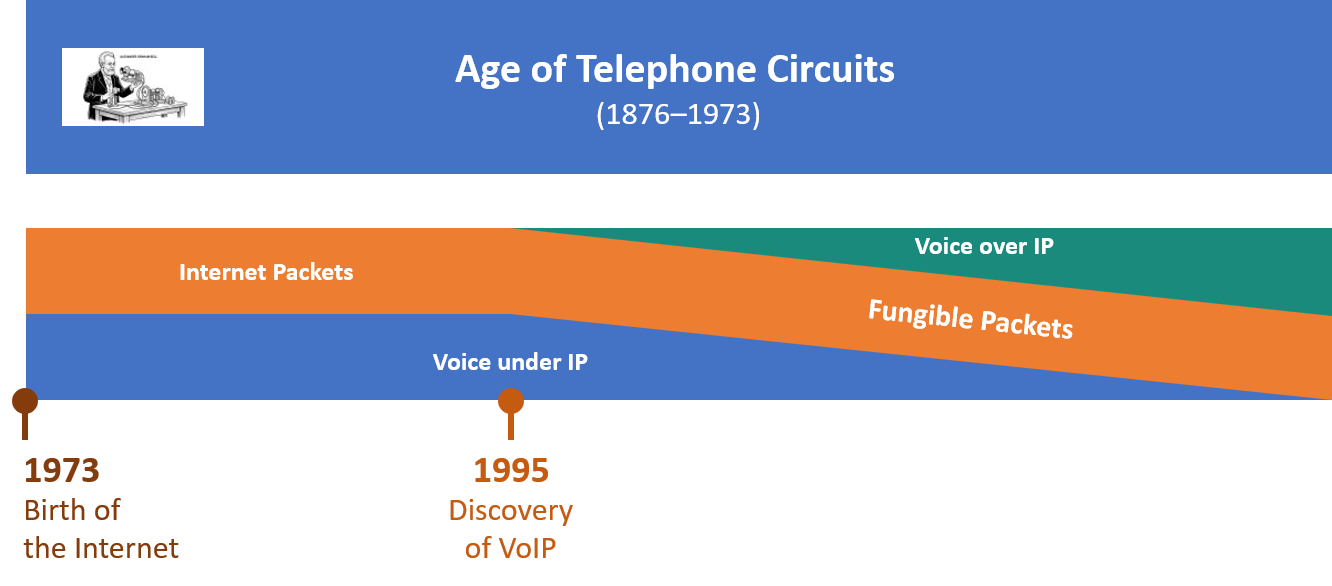
Today the world has turned upside down. The packets are no longer riding on the circuits designed for synchronous voice (and other services). The packet infrastructure is fundamental and voice is now going over IP rather than being the underlying technology. But it’s also fundamentally different, the packet infrastructure is not a dependency layer, it is but one of many opportunities we can take advantage of now that we’ve factored the services from the pipes.
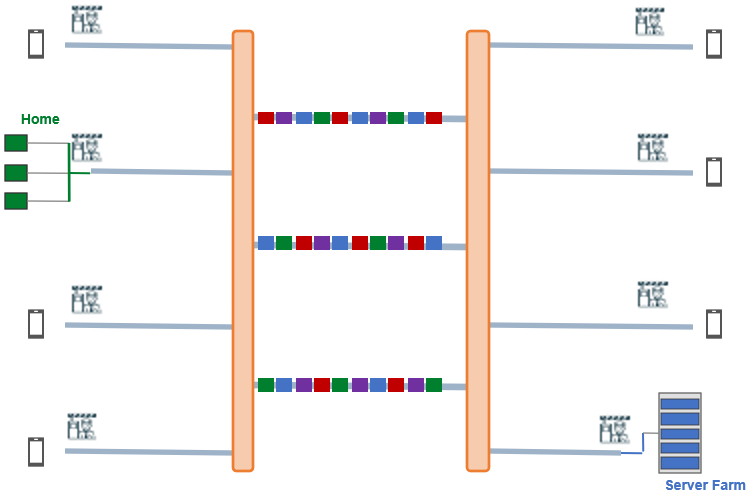
We repurposed the pipes by converting them to packets so that we can share the capacity. With packets we no longer have circuits busy – we share the capacity just like cars share the road but with the major difference that we don’t have the limitations of physical objects. With smarts in our devices we can tap into the native packets without needing an intermediary to maintain the taut string – we don’t need circuits!
I use the term fungible packets because no one between the endpoints knows anything about the packets. In effect they are all identical. This tokenization is similar to what LLMs do and is a powerful idea in its own right. The packets don’t represent a layer – they are a resource that can be used not a layer we build on top of.
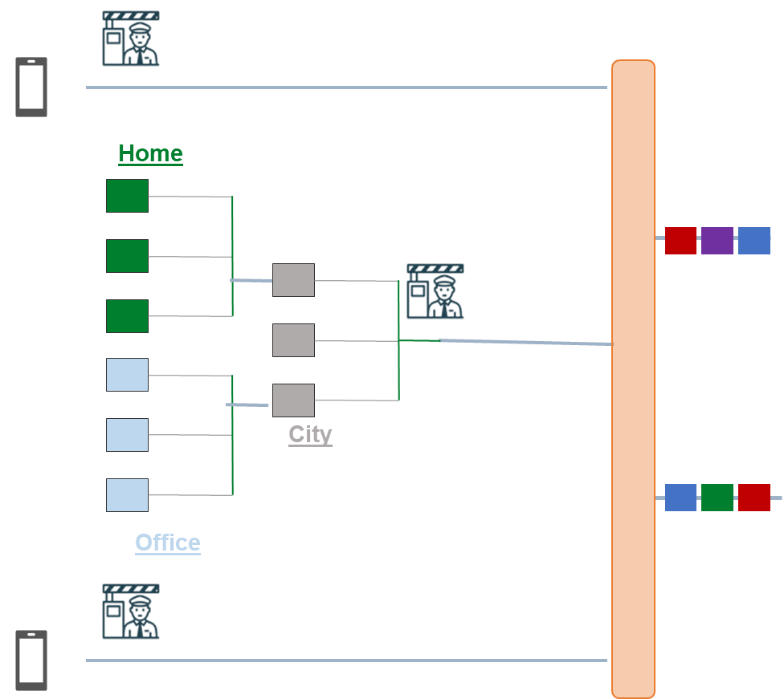
But there is a fly in the ointment – those toll booths are still there! Why are we paying as if we were filling pipes now that the facilities are common infrastructure and we don’t even need the construct of pipes? And broadband is indeed a pipe, and the idea of competing pipe providers doesn’t make any more sense than competing sidewalk providers. In fact, by factoring out the infrastructure as a common facility we remove the third party second guessing our connecting and forcing us into the scarcity of old school telecom.
This may not be obvious because, as in the example of a home network, there are no toll collectors for each PC. That’s because we pool our resources and pay for a shared connection for all the devices in our homes or office so that we can act as if they are free to use.
While ideally we should convert to an infrastructure model in one fell swoop we can take an incremental approach and start local by moving the toll collector one step away by adopting an infrastructure model for a community such as a city and have only a single toll collector with the city as a single payer. The economics of free to use shared infrastructure are compelling and we’ll see this model repeat at scale with adjacent communities sharing fatter pipes till the concept of telecom appears strange. Yet that’s just what we accepted in the 1990s when you needed to pay for a separate IP address for each PC as if it were a phone line. As we shift to infrastructure the idea of a third party in the path second-guessing innovation and demanding a payment will seem just as absurd.
The Age of Telephony
In 1876, an acoustic psychologist and savvy businessman, Alexander Graham Bell, was awarded the patent for the telephone that enabled people to communicate using voice at great distances. It has been 150 years, and the world is very different, yet that invention and the business of telephony seem to still be going strong.
The reality is very different, and telephony is no longer a service but an application inside our smart devices called smartphones in the same way we still talk about dialing phone calls or taping conversations. Skeuomorphism leaves us trapped in the past perpetuating a false narrative.
In May of 1973 I happened to take a class in which we studied a radio packet network in Hawaii – ALOHAnet. The student sitting next to me took that idea using a coaxial cable as the medium and called it Ethernet. I also happened to take a class in psycholinguistics. At the time the full significance of the packet-based networking and its relationship to psycholinguistics wasn’t obvious to me.
My real education began in the mid-1990s when I first started doing my home networking project at Microsoft and had to get deeply into Internet protocols and then attended a workshop by Lee McKnight on the nascent idea of voice over IP. I later wrote a column for Jeff Pulver’s VON Magazine.
This came together when I wrote a column on VoIP as an inflection point. Very simply, the entire telecommunications industry is based on having two “dumb” endpoints that depend on a network operator to provide an isochronous path to preserve the waveform.
The image of two children using two tin cans and a string is a very good representation. The endpoints are just speakers and microphones, and it is necessary to keep the string taut to provide an isochronous path for the waveform. By doing it electronically we can carry this sound wave over long distances, but analog signals degrade over a distance. This is why Claude Shannon’s work was so important. Digital signals, zeros and ones, could be regenerated over any distance because you know that it is a zero or one so you can refresh it at every stage along the path.
But, ultimately, it was still acting like the original telegraph lines with a separate wire necessary for each conversation. You paid for the time this pipe was occupied to send the telegram by being billed for the time the wire was occupied. This measure was carried forward with the phone calls being measured in message units until the introduction of the cell phone when we used the word minutes for the same thing.
This notion of a path being occupied is implicit in the very terminology we use. We have the concept of a phone call that has a duration and the line is occupied even when there is silence. When that line was in use no one else could use it – the provider allocated capacity in fixed units to each call and when all the paths were in use you got a circuits busy signal. This was a crisis at times like Mother’s Day, and everyone wanted to call home.
The Transitional Period: Dualism
I refer to this transitional period as dualism. We had a packet-based network for “data” and another network for services that required, or as we’ve learned, were assumed to require carefully managed isochronous paths – the pipes. The transitional period actually goes back to the 1970s when digital technologies meant that we could composite the path out of digital pipes without having a single owner but that wasn’t obvious.
It wasn’t until the 1990s with the advent of online services that the first major transition occurred. AOL in particular forced a change because the modems mimicked phone calls and so kept the path occupied as long as you were online. Doing my master’s thesis I looked into billing for phone calls and found out that, in the US, we had the concept of unmeasured usage where you paid once no matter how long the call was. That was because the US users demanded detailed billing records which were deemed too costly compared with going with a charge per call. This quirk was a key enabler for the nascent online services industry while at the same time it was a catastrophe for the telecom industry because the lines were all occupied for long periods.
The key was to convert the faux phone call into packets which enabled sharing the facilities. It is similar to the way cars share a road rather than having a dedicated lane for each trip. This is a clear demonstration of how using packets instead of circuits unlocks abundance in essentially the same way that allowing cars to share lanes unlocks capacity unavailable if we had to dedicate a lane to each car trip. The physical analogy is far from adequate but gives us a simple way to visualize how packets enable us to share capacity and unlock some of the potential abundance. I say some because we are still building the infrastructure on top of legacy infrastructure that confines us to narrow pipes both because that’s the way we always did it and because such pipes are necessary for a business model that requires connections to billable paths for no essential reason other than billing for the paths. Yes, the logic is circular, which makes it hard to see the reality from within the system.
The Opportunity and Tragedy of the Broadbands
Here’s where the story gets personal and that class I took in 1973 becomes relevant. In the mid-1990s I was at Microsoft working remotely from home. Of course I had an Ethernet-style network at home. I realized I could use a technique called Network Address Translation (now called a router) to share a single connection among all the computers in my house. More important is that I shifted the model from accessing the Internet (as in dialing into AOL) to being a full peer participant able to host a web server at home. This was a mindset borne of my experience with campus networks in school and in offices. I also had the vital resource of friends (such as David Reed) who could help me get up to speed.
At the time the phone (and cable) companies were excited by the data pipes (broadband) they would use to sell new services without any new cost for infrastructure. An additional phone line had no new costs – just pure profit! And since each machine needed a separate dialup line it seemed natural to price each IP address as if it were a phone number. AT&T paid billions for MediaOne so it would sell new services like online shopping because they owned the pipe.
Perhaps my boldest claim is that I could make this simple enough so that home networking didn’t need installers and would “just work”. It was also hard for people to see the value at the time just as I couldn’t get people to see the value of email in the 1960s.
One of the keys to understanding the Ethernet is recognizing the packets have no intrinsic semantics. At the most fundamental level you cannot know the meaning of the packet by observing it. If you see a “7” what does it mean? This is even more problematic as encryption is now the norm. There is no way a third party, like a carrier, can make any promises – not even the simplest promise of remote delivery. As an aside, this is the same as the tokenization that underlies LLMs.
This meant that the providers faced an existential threat from their customers who could innovate far more rapidly than they could. The packetization severed the provenance – the relationship between the packet in transit and meaning or value. In fact, value is inversely proportional to the quantity – the terabit it takes to see a video stream (AKA, movie) has less value than the hundreds of bits it takes to summon help. And those bits are not physical objects. Someone looking at an envelope could not read the message inside.
I’ll write about the full impact after I get to VoIP. Broadband is a tragedy because we confuse despite with because of. We talk about broadband and extending as being synonymous with “The Internet”. Broadband is still a series of pipes with the value and innovation 100% outside the pipe. We are left with the constraint of pipes – the inability for agile routing. While paying the price for 100% redundant infrastructure. Refactoring power distribution in the 1930s to separate the grid (as a transport) from the power source enabled vibrant competition in power sources. Having each provider [sic] with its own grid prevents effective competition and innovation while denying communities control over their own services. Dead spots in wireless coverage are one result.
Home networking took advantage of the opportunity and repurposed it despite the telecom industry which had deployed it as pipes to provide its own services. The tragedy is that public policy is entirely centered on more broadband pipes. I’ve compared it to laying down railroad tracks so that they can be repurposed as basically paths.
In 1996 I proposed replacing the line cards in central offices with ones that would automatically take existing phone lines and convert them to multimegabit DSL lines. This would have enabled everyone to be interconnected with the rest of the Internet without any additional facilities. Of course we’d want to add capacity but that would have followed when coupled with communities able to invest in their own future rather than accepting what is profitable to telecom providers.
But, again, I’m getting ahead of myself.
Voice over IP – The Inflection Point
The reason I say that VoIP is an inflection point is that until VoIP we needed dual infrastructures. With VoIP we no longer need a dedicated telecommunications infrastructure!
It is difficult to understand VoIP through a telecommunications lens since it is not a service but rather a technique. This isn’t obvious at first because it seems that we have providers like Skype and Zoom. These do add value, but they are services outside the “network” itself. (I put the word network in quotes because saying the facilities we use to do networking is a bit cumbersome, but this is not the network in the sense of telecommunications). Jitsi is an open-source VoIP implementation.
Innovation is driven by constraints and lack of provenance means there is no way for an application to buy preference from a path provider. This created the same kind of constraint as in the original ALOHAnet. So programmers did what they always do – they programmed around the constraint. If you didn’t get an acknowledgement, you retransmit and eventually you’ll get the file transferred. The TCP is the same idea writ large, and it is called Transmission Control Protocol because it controls the flow in the way a traditional telecommunications control plane cannot because it has knowledge of the applications and is able to adapt to what is available such as falling back on text messages rather than having a choice of all or nothing. The telecom style connectivity has been fatal to people with a weak cell signal leaving them unable to seek life-saving help that could’ve been summoned with a text message.
One aspect of VoIP that makes it hard to understand is that it is based on what I’m calling Opportunistic Economics. I did a quick check and didn’t find literature that shows an appreciation of the concept of adjusting what you do to take advantage of opportunities with an appreciation of how this is a powerful idea rather than opportunism as a pejorative. It flips cause and effect because the capacity created for the web created the opportunity for VoIP by increasing the capacity so that the odds of congestion went down. In economics demand creates supply. The demand for web capacity drove the supply of overall capacity. And because everything is normalized to fungible packets, that capacity created a resource for innovations such as VoIP and streaming.
Telcos were unable to make a business of the picture phone because it required dedicated capacity and could not take advantage of opportunistic capacity. Its business model was based on the idea of the conversation occupying a pipe and there is only so much pipe capacity available and it must be carefully doled out.
As I mentioned above, I took a class in psycholinguistics and one key point is that the meaning of speech exists only in our minds and not in the waveforms – the taut string. This plays out in a number of ways.
The simplest is that one reason that telephone companies deemed voice over a packet network to be impossible is that they framed their thinking around “dumb” endpoints. The slightest distortion and you’d hear a click or other artifact. This is despite evidence to the contrary in the utility of early cellphones despite the quality problems. Again and again the telco lens blinds us to new possibilities.
Once we state the problem as keeping the string taut we forget that was a means that made sense in the 19th century, but the real goal is enabling people to communicate. It is telling that Bell was a professor of acoustics and understood the value of enabling people to communicate without the intermediary of a telegraph operator, but he was limited by the technology of the day. Professor Elisha Gray, who also filed for a patent about the same time as Bell, was a scientist who didn’t appreciate the social value of the talking telegraph and treated it as an incremental improvement so was in no rush to patent it and lost his opportunity. Incidentally, JCR Licklider (Lick) and Bob Taylor, key figures in the evolution of the Internet, were acoustic psychologists. In fact, when taking psycholinguistics, I ran across a paper by Lick from 1949 showing that in noisy environments preserving the waveform made things worse.
Stepping back, the ability to fall back to text or move ahead to video is a good demonstration of giving the users flexibility in how to communicate depending on the opportunity. This issue is far more fundamental than it seems at first because the very ability to represent any “content” as bits taps into far more fundamental concepts that I touch upon in The Age of Software.
Infrastructure for the 21st century
Today’s connectivity (the Internet for now) has done a brilliant job in repurposing and papering over the limitations of the 19th century technology and business model of telecommunications but it’s a problematic foundation.
A key idea in software is factoring problems. It is very different from the idea of layered abstractions in that it is not a dependency model. The components are independent and treat the other factor as an opportunity. This manifests itself as the end-to-end argument which I formulate as the relationships between the endpoints being independent of what is between. Instead, if you want to send packets then you have to adapt to what is available.
This was not the original design point but is, again, the product of a constraint – the lack of a provider in the path assuring delivery and maintaining the relationship between the endpoints. It’s unfortunate that ALOHAnet and Ethernet were called networks because, as I’ve noted, the word network lacks intrinsic meaning, so we think of a telecom network not an abstract network but there is no network provider! And that forced the innovation that gave us the Internet. The Internet is a break from the past because responsibility is shifted entirely outside of the network unlike the ARPAnet that preceded it.
This concept of independent relationships is called binding and is a deep topic in its own right and a full discussion is beyond the scope of this essay. One example is useful. Both Ethernet and the Internet use packets but there is no layering. What happens is that Internet packets are delivered locally using the wires in your house as a resource or a wireless path as an alternative. I have two connections both for redundancy and for experimenting. I traced a packet from my Verizon connection to my Comcast connection, and the packet went through Chicago even though the modems were inches apart. It didn’t matter – it just happened to work. It wasn’t dependent on a particular topology nor was it able to get better treatment.
It worked because I had an account in good standing with both providers [sic]. That account relationship is utterly decoupled from the relationship between two endpoints – such as a control panel on my wall (a repurposed smartphone) and a lightbulb. That relationship is point to point. The control panel (app) just sends a message directly to the bulb and it doesn’t matter what the actual path is and it has no control over the path. Fortunately, the path tends to work well because the demand generated capacity.
But connections cannot get past the business model which requires putting a tollbooth or turnstile in the path. This is about the economics or business model of the telecommunications industry. It is a business model based on the idea that our speech (and other content) flows through pipes as a consumable like water. That did make sense when the taut string was necessary. Now that all the services are created outside the facilities we use to do networking (the networking is now a software construct) is like roads and sidewalks as infrastructure not service delivery pipes. As we’ve seen this approach creates scarcity! And prevents innovation by putting a third party in the middle of every conversation and relationship!
Imagine if we paid for other infrastructure like sidewalks by putting a turnstile in front of every house.
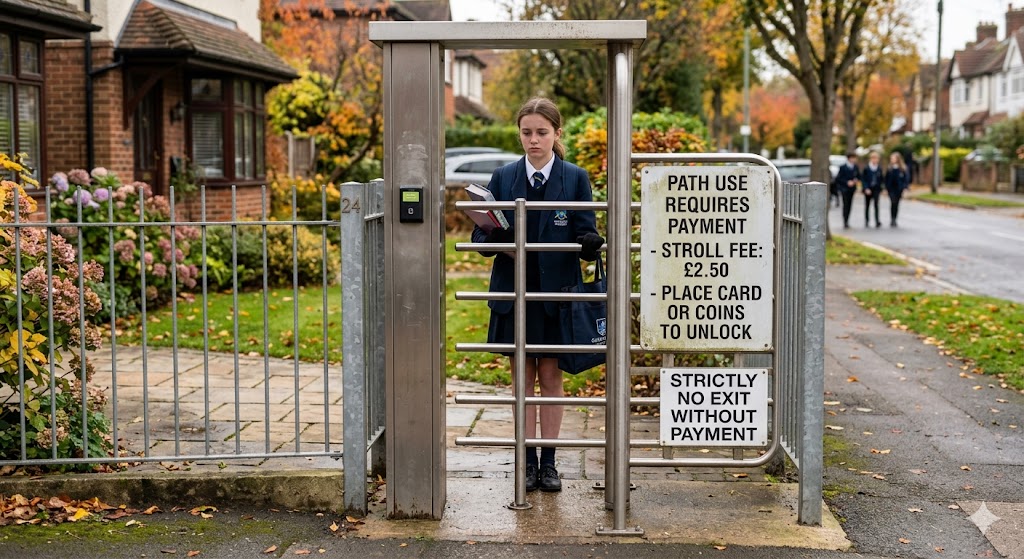
Putting a tollbooth in the path of every conversation is no different. The wires and fibers are now no different from the sidewalks and roads in being nothing more than a way to facilitate movement. You don’t really need sidewalks – they just facilitate strolls. And we pay for the facilities in a way makes them free-to-use. Imagine if we charged for strolls independent of whether you were going across the street or walking across the country. The value of the stroll is completely independent of the number of steps and the cost of concrete. But the turnstile approach comes at a high price: It disenfranchises people and creates a barrier to education and participation in society. It also creates a vast bureaucracy to prevent free riders (OK, strollers). After all, if we allowed people to walk freely how would we pay for sidewalks? That seems like a dumb question, but it is no different than the subscription model for using wires to facilitate connections and conversations.
How Did we Get here?
We’ve seen the design point of the taut string. Even before that, in the age of telegraphy, telegrams were treated as freight that occupied wires. In more irony, Bell used the money he was given to develop the harmonic telegraph for sharing wires to invent the telephone.
With the advent of radio, this assumption of the need for a taut wire was extended to the radio domain where harmonic resonance actually worked. Each conversation would be assigned a dedicated frequency that you could listen to using a simple tuned circuit. It seemed miraculous and was deemed necessary. But the problem is that, once again, the algorithm created scarcity! That led to the idea of having a body to assign frequencies – the Federal Radio Commission. It was understood, in the US, that this would violate the US First Amendment but that was a necessary price to pay at the time.
The other factor was that the economics of telecom were problematic. It was similar to the problem faced by long distance railroads in the 19th century – high capital costs and little differentiation leading to the creation of the ICC (Interstate Commerce Commission). Richard White does a great job of explaining in his very readable book – Railroaded. In fact the Federal Communications Commission was spun out of the ICC! Today the ICC is no more but the FCC is still with us because the efforts to bring order to telecom have perpetuated the scarcity of the pipe model and economics. Unlike the transition from railroads to roads, the transition to packets is both invisible and counter-intuitive! So we fall back to the metaphor of pipes.
Yet we have proof of concept for the infrastructure model. Essentially 100% of the homes, college campuses, and businesses use an infrastructure model. Yet, somehow, once we leave the premises, we go back a century. New infrastructures are hard to accept. How many people died due to resistance to germ theory and without the Big Stink, when would London have built its sewer system?
But such a transition is necessary. It’s not simply the billions, if not trillions of dollars that go to rent-seekers and thousands of dollars each household spends merely to communicate. We are denied a resource that is vital for innovation, public safety and so much more. But that’s a topic for another essay.
The key is to shift from the scarcity-creating rivalrous business model of telecommunications to a non-rivalrous model of infrastructure. The big difference is that roads can cost a million dollars per mile while connectivity is a one-time cost that is in the thousands of dollars. And that cost can plummet thanks to the ability to innovate in using the vast abundance of wireless and wired capacity available once we shift to a public packet infrastructure. One in which communities invest in their own future. We can shift to a market-based approach rather than an anti-market business of telecommunications now that those services are apps.
Wired connectivity is already packet-based, and cellular and Wi-Fi connectivity is packet-based. We need to complete the process by using the packets to share the wireless bands. One bonus is the choice of bands becomes an engineering decision rather than ownership going to the highest bidder who then hoards the capacity.
The cost of transition is less than zero. We can start by using the existing facilities as-is and just changing the way we pay for the facilities. All the services can share a common infrastructure, and we eliminate the very complex system necessary to prevent people from communicating freely. Instead of the brittle failure-first model of telecom, we’d have an infrastructure that provides myriad opportunities for success while tapping into the effectively unbounded capacity once we escape the confines of pipes.
Further Reading
- Refactoring Consumer Electronics. I wrote this column in 2013 deriving the Internet from first principles. I used the term refactoring as the key idea partially because the audience was the Consumer Electronics Society (now the Consumer Technology Society) rather than a traditional networking society. It turns out that was a fortunate choice because the real audience is outside the legacy telecommunications world and factor is indeed the key idea.
- I wrote Beyond Limits in 1996. Writing it crystallized my thinking about how factoring (to use my current terminology) is key to the kind of hypergrowth we associate with Moore’s Law.
- In Promises vs. Discovery I wrote about how what I now call opportunistic economics creates abundance.
- In Public Packet Infrastructure I explain the concept of the Public Packet Infrastructure.
- In VoIP Inflection I explain how VoIP works and why it is a break from the past rather than the next step in the progression of voice telephony.
- Home 2024. Direct relationships (bindings) are not just about voice calls; they are a fundamental concept for understanding systems and relationships.
You may also be interested in this article Elisha Gray Obituary and my conversations with Perplexity: Bell as an Acoustic Psychologist.
Epilog
What next? Once the services are decoupled from the wires, then we have a physical infrastructure that is independent of the services we create in the same way that cement and macadam are not services but are used by people who can stroll or drive or take a bus.
The key is that the transition from the legacy policy of charging for the facilities as if we are buying services can be very smooth. Just as you own your home network and corporations own their network, communities can own their shared facilities and then buy further connectivity from a legacy provider. You own your home network and pay essentially nothing once you’ve purchased the gear. The monthly fee is for the pipe to the outside world.
A city can do the same thing by owning its local facilities and buying further passage from a provider. Adjacent communities can interconnect directly. It doesn’t have to be a jarring change. One can start by adopting a transitional model such as by having the community move to a single payment model with the city paying the existing provider. The problem with the old model becomes obvious once you realize that you only need one provider. The footprint can grow as adjacent communities transition.
The key point is that the only thing keeping us in the thrall of legacy telecom is our acceptance of the myth that we are still paying for services though that hasn’t been true since the telecom industry itself converted to using fungible packets. Though, strangely, it has resisted that change as it hoards wireless bands. With understanding it will be difficult to accept the givens of the past – no matter how hard the FCC tries to maintain 1934 compatibility mode.