


It is best to view this online at the IEEE site. The Doc ID is 10.1109/MCE.2025.3599692
My Dumb House
My house is dumb. It doesn’t get in the way of my applying my smarts in the same way the Internet can be smart because the underlying networks are dumb.
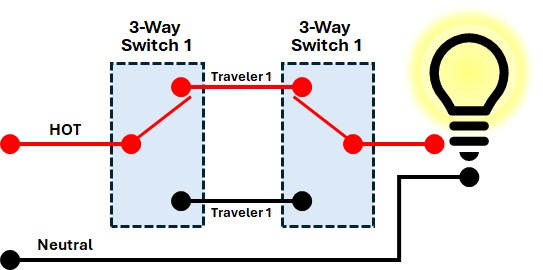
It wasn’t always. With the advent of electricity it was converted from gas lighting to electric (with wires often utilizing the existing gas pipes). That enabled the innovation of remotely controlling a light by running a wire from the switch to the bulb. It allowed for wired logic as in this example of two switches to control the bulb.
This is similar to the smarts in a telecommunications network or railroad tracks. I admire the engineering that has gone into building such systems, but we need to recognize that building such smarts into the infrastructure comes at the cost of second-guessing and limiting innovation.
The Dumb Factor
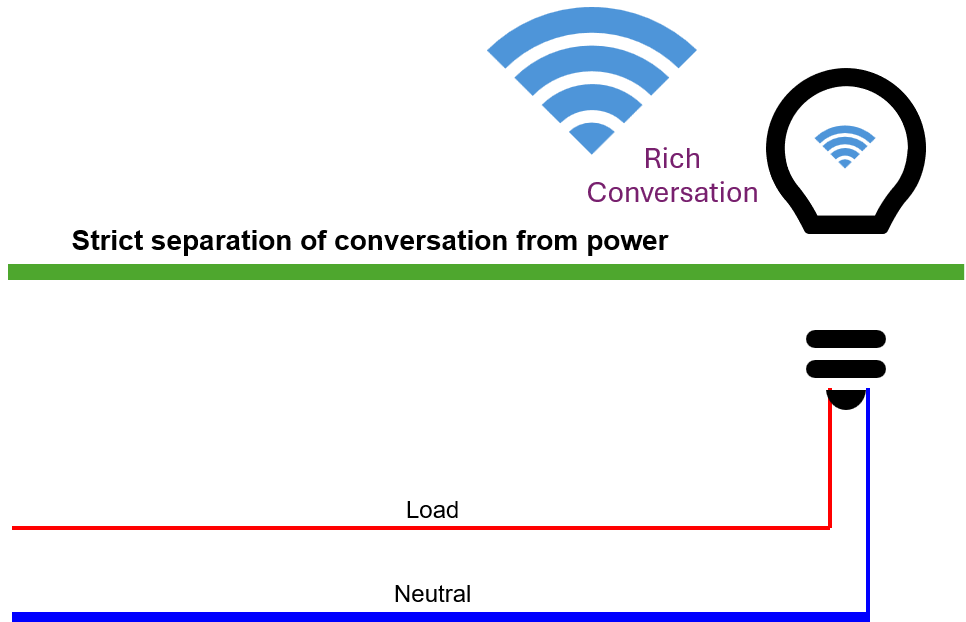 In sharp contrast, my house is now dumb -- it providers power but doesn’t dictate the behavior of switches and devices. There is just common power going to a bulb. I’ve factored my house wiring so that I send messages to the light over Wi-Fi (or any generic packet medium) independent of the underlying wiring plan. The power distribution and the availability of generic connectivity become resources we can use to apply our own smarts.
All I have to do to put a in a new light is just provider power and I’m done. I just use any power source and assume connectivity (networking). I can then use the smarts in my software to bring the house “to life.”
 I can do logic in software such as having multiple control sources (a far more general concept than just a switch). I’m not simply “automating” the switch, I’m rethinking the relationship with the light source. It’s not simply command and control but a conversation. I can have a button that sends a “turn on” message or I can have an application that I wrote to make sure that my porch is lit up at night. Using words like “coding” and “scripting” miss the new of thinking.
The dumb house is a resource that has allowed me to learn by doing. One of the early lessons as that simple scripting (automating) had limited value. Having control surface near a door (yes, like a light switch) worked well. Having sensors to automatically turn on a light lacked the nuance need for the real world. I decide whether to turn the light on based on a number of factors including if someone is asleep but how do I codify that into rules for motion detector?
Before I continue I need to emphasize that I’m using lighting as an example because it’s simple to understand. The concepts are far more general. I’m not turning a light on or off, I’m enabling myself to see a meal, be it by turning on a light or opening shades.
My Smart House
I live in a “smart house,” or so it seems. If I have an app that senses the lack of sunlight or looks at the clock, it seems as if the house is smart. But that’s misattribution. I can do smart things because my house is dumb and doesn’t get in my way! This is very much like the way the Internet has enabled innovation by mooting the intelligence telecom network.
Over the last few years I updated my approach to home control and completely rewrote the system in TypeScript. One reason was to clean up, my earlier implementation while staying compatible with the earlier architecture. I’ve written about that in Home20241 and Home20232. The key point is that I now think in terms of bindings rather than wires. Initially I had followed the common practice of naming a bulb as “living room” as per standard practice. Today I recognize that we have many different systems and views and, as with good database design, you don’t put semantics in the plumbing. Instead the physical bulb would have an intrinsic identifier (such as the MAC address) that is mapped to an IP address (in the DNS) and to a descriptive name in a database used for mapping. The bulb can also be part of abstract collections such as “kitchen lights.” I also identify locations such as mounting points (sockets).
In part it was inspired by using Ubiquiti’s device to manage the set of networking facilities. I wasn’t managing the network as such but the set of devices. Ubiquiti does a lot more “favors” such as trying to filter web traffic but, fortunately the system is well-architected so I can ignore those “favors.”
My approach may sound complicated, but the key is in the tooling. To swap a bulb I just identify the bulb and say where it is as in “ksink6” which is the position on the sink side at the left end. I can do with using my flexible swapbulb command which makes it easy to describe the change.
This is in sharp contrast to Alexa which requires scrolling through hundreds of devices in order to make a simple change. I happen to have almost three hundred endpoints (IP addresses) in my house – not that much if you consider that each bulb (the kitchen has sixteen spotlights) and switch (controller) etc. are endpoints. Plus each appliance, camera, doorbell etc.. I’m very aware of the challenges of scaling which is why what I learn doesn’t stay at home but applies to infrastructure in general. Alexa does have an API, but I need to registers Alexi Business Account which I interpret as Go away kid, don’t bother us.
I started with physical metaphors (replacing wires) but now think far more abstractly using concepts such as binding. This is a very deep topic in its own right. For example, we tend to try to understand systems and think of physical wires as being simpler than software-defined relationship because we can see them. But with the right tooling, I argue, my house is far simpler because the tools can find the simplicity in context without being limited to the use-case defined by the wires. For example, having multiple switches controlling a light may seem simple because we’re used to it but how do you know if the light in another room I can’t see? If there is one switch up it may mean it’s on but with two that toggle I can’t rely on the position as an indicator. For that matter, the switches are rarely labeled.
In sharp contrast my software (running in a web browser on a smart phone acting as “light switch”) shows the current state of the light, and you simply turn a light on and off without trying to guess the state. Adding another control is trivial because you don’t have to reconfigure – just assign the location name to the button on the screen and you’re done. Using software might seem more complicated but it’s simpler for the user and is expressed as rules rather than as a complicated wiring pattern. Notice I said location name, not bulb name, since that’s the relationship that matters3.
Which brings us to smart cities …
Smart Cities
Smart cities are not a new idea.
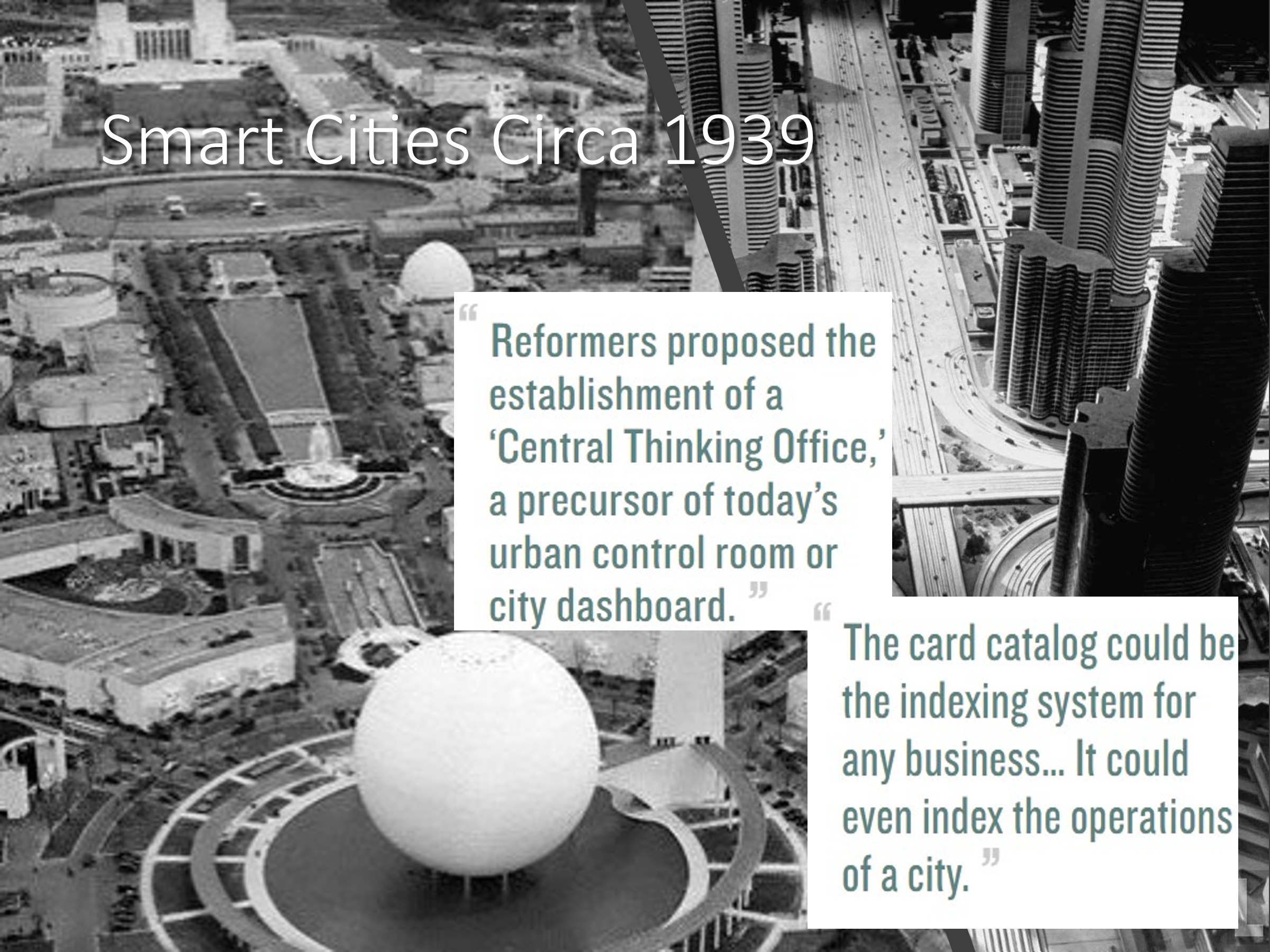 What is different about today’s smart city?
|
I asked an LLM: What is a Smart City? A smart city is a municipality that uses information and communication technology (ICT) to increase operational efficiency, share information with the public, and improve the quality of government services and citizen welfare. Smart cities leverage digital technologies and data-driven solutions to enhance the quality of life for residents, improve sustainability, and optimize the efficiency of urban services. The concept involves integrating various interconnected systems, such as Internet of Things (IoT) devices, sensors, and analytics platforms to create a seamlessly connected and technology-based ecosystem that smartly responds to the needs of its inhabitants. Smart cities collect and analyze data from IoT sensors and video cameras to "sense" the environment so that city operators can decide how and when to take action. |
The 2025 vision of a smart city isn’t that different from the 1939 version. The big difference, of course, is that smart cities like Corel Gables4 have implemented many of the services and have invited the community, including universities to use their platform. The key enabler is modern computing and open connectivity. As wonderful as these ideas are, they are still tied to the idea of the city being smart and framed in terms of services. This is similar to confusing the Internet with applications such as Facebook which happen to use the Internet.
This framing also leads to privacy concerns when the focus is on the city knowing everything in order to provide services.
Factoring
Factoring is a powerful idea and is particularly important on software where we can refactor systems as our understanding improves.
Connectivity
For the city, we can factor out the key connectivity in the same way I factored out the wiring my house and connectivity in my house. A Public Packet Infrastructure5 is the public version of the dumb connectivity in my house that’s not obvious if we view it through the lens of a service or a way to “access6” something using broadband “pipes”. Thus we treat it like an online service and require people “login.” The argument that it is unsafe to provide open connectivity reflects the continuing challenge in defending free speech and free sidewalks. We must be wary about building social policy into fundamental infrastructure.
This is why it is so important to get our metaphors right and view it as infrastructure like roads and sidewalks. Imagine if you had to login to the sidewalk or pass through a turnstile to take a stroll.
Another reason why it may be difficult to understand the power of the PPI is that such sharply defined interfaces are the exception. When we build infrastructure such as roads and sidewalks we are locked into our early design decisions.
Metaphors matter – stealing Wi-Fi is like stealing a base in baseball and not like stealing an heirloom.
APIs and Binding
Another lesson from the world of software is that important of programmatic interfaces. We’ve seen the value in applications for travel planning. In Boston, for example, the transit authority (MBTA) doesn’t do its own apps but enables others to build them.
One creative application is a board showing train positions in lights. Using APIs mean that I’m not limited to the original use case. By factoring the project into independent elements we can enable rapid innovation and experimentation at low risk.
Privacy and Trust
Googles “Sidewalk Labs7” seems very much like the 1939 model of a centralized approach. Of particular concern is idea of paying for it by monetizing the city’s data. The group was also behind LinkNYC which “offered” free Wi-Fi paid for by advertising. No wonder there are serious privacy concerns.
It also shows naivete about finance. Nothing is “free,” but we can have funding models that are generative such as paying for connectivity in a way that makes it free to use. Public transit makes a city viable and making it self-funding can threaten the viability of the city.
There is a need for the city to be aware of the residents activities but only to a degree. Having a user “login” into the Internet [sic] we create an unnecessary ability to track people while also limiting the ability to use it as infrastructure.
Alas, in the age of LLMs (AI), the challenges of privacy and trust become more complicated because those systems use all available information sources to do their magic but with no easy way to draw boundaries. This is a worrisome issue beyond the scope of this essay.
Generative Infrastructure
Rather than smart cities we need to think in terms of generative infrastructure. By applying concepts from software such as factoring (and refactoring) and having well-defined Interfaces (APIs) and understanding concepts such as binding rather wiring, we create opportunity for innovation and give everyone the chance to contribute.
In writing this column I was distracted by squirrels upgrading the tooling I use to manage and post messages. The rapid improvements in tools and capabilities is a reminder to be wary of building smarts into the infrastructure. Create dumb facilities that enable rapid innovation that can use to create better cities.